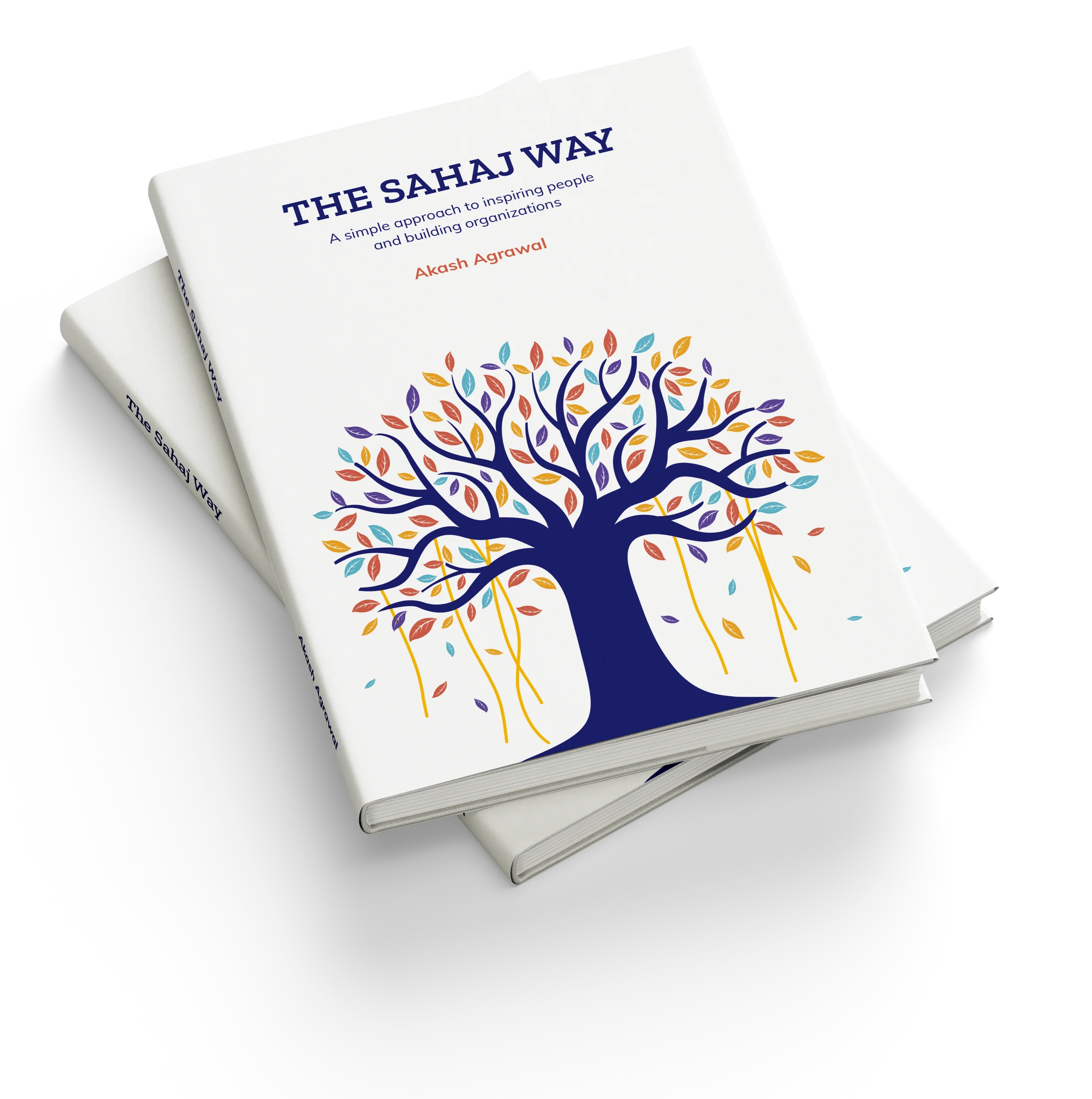
A Simple Approach to Inspiring People and Building Organizations
“We didn't write this book to showcase a flawless corporate roadmap or to brag about our successes; we wrote it to share our decade-long journey with friends, clients, and future teammates.
Building Sahaj has been a beautiful, chaotic, and sometimes painful social experiment. We hope that as you read about our stumbles, our breakthroughs, and our failures, you feel like you are sitting across from us at a local tea joint, getting to know who we really are.”
On a late-night flight, Sunder cornered Akash to pitch a software company, pulling in Mr. B the next morning over chai at a local tapari. We trashed the standard three-year break-even spreadsheet for a harder purpose: ending the systemic exploitation of developers and clients. With co-founders Nitin and Bala, we set out to build a completely flat, non-hierarchical community.
hover to read →
Late 2014
The High-Trust Ed-Tech Turnaround
We won a major contract with an ed-tech non-profit building a gaming and machine-learning platform for 100 million students. When a critical data loss hit the field, our lean team worked day and night to diagnose the system, proving the bug lay outside our code. Instead of playing vendor blame-games or billing extra hours, we solved their crisis, cementing a trust that lasted over three years.
hover to read →
Year One
The Open Salaries Guessing Game
Sparked by a developer asking to see the hidden salary files in our Google Drive "Founders folder," we debated dismantling hidden compensation. To break weeks of tension, we gathered in a room and guessed each other's salaries using 13 parameters. Almost everyone landed within 10% deviation, proving secrecy exists only to control, so we opened the salary file globally.
hover to read →
Late 2017 – 2018
The Eagerness to go Global
Overconfident from our Indian success, we expanded to the U.S. and put a 10-person payroll in place before securing a single client. Local prospects balked at our premium rates, and the payroll drained our cash reserves, forcing founders to skip salaries and delay India's payroll. In a humbling chapter, we laid off the entire U.S. team to protect the 40 families back home.
hover to read →
Mid 2018
Cautious Twin Bets on Pune and the U.K.
Smarting from our U.S. collapse, we cautiously approved Raj's pitch for Pune and Nitin's push into the U.K. Learning from our over-zealousness, we tested demand first, starting with shared co-working spaces and lean diagnostic engagements. Both regions turned into goldmines, landing massive clients and cementing credibility for our offshore delivery model.
hover to read →
2019
The Lean Connected Vehicle Platform
Partnering with an Indian automotive major, we set out to build a custom connected vehicle platform to monitor commercial and passenger trucks. Instead of throwing 100+ conventional consultants at the problem, a lean team of just 6 or 7 Pune Sahajeevis took it on. Within eight months, they built a scalable system that today runs smoothly on lakhs of vehicles across the roads.
hover to read →
Post-COVID
The Return-to-Office Mandate Mistake
Worried about remote grads feeling lost without mentors, we picked up the corporate "stick" and mandated three days a week in office. When attendance stayed thin, we threatened remote workers with salary cuts, which instantly triggered proxy attendance and toxic monitoring. Realizing we were destroying the trust Sahaj was built on, we called a Gram Sabha, admitted our mistake, and rolled the policy back.
hover to read →
2022 – Today
The IPO Sugar Rush & Sane Pause
Growing rapidly, we decided to pursue an IPO, hoping to prove a clean company could stand tall on the public market. The goal triggered a toxic sugar rush of aggressive hiring, inflated projections, and pushing our people to "do more, build more, hire more." Realizing the cost was outstripping the benefit and poisoning our soul, we paused the IPO to return to the simple joy of craftsmanship.
hover to read →
Glimpses, Unfiltered
Chapter 03
A Big Win - Trust
It was March 2014 and Sunder, Mr. B., and I were out of jobs. Bala and Nitin were to join us from May.
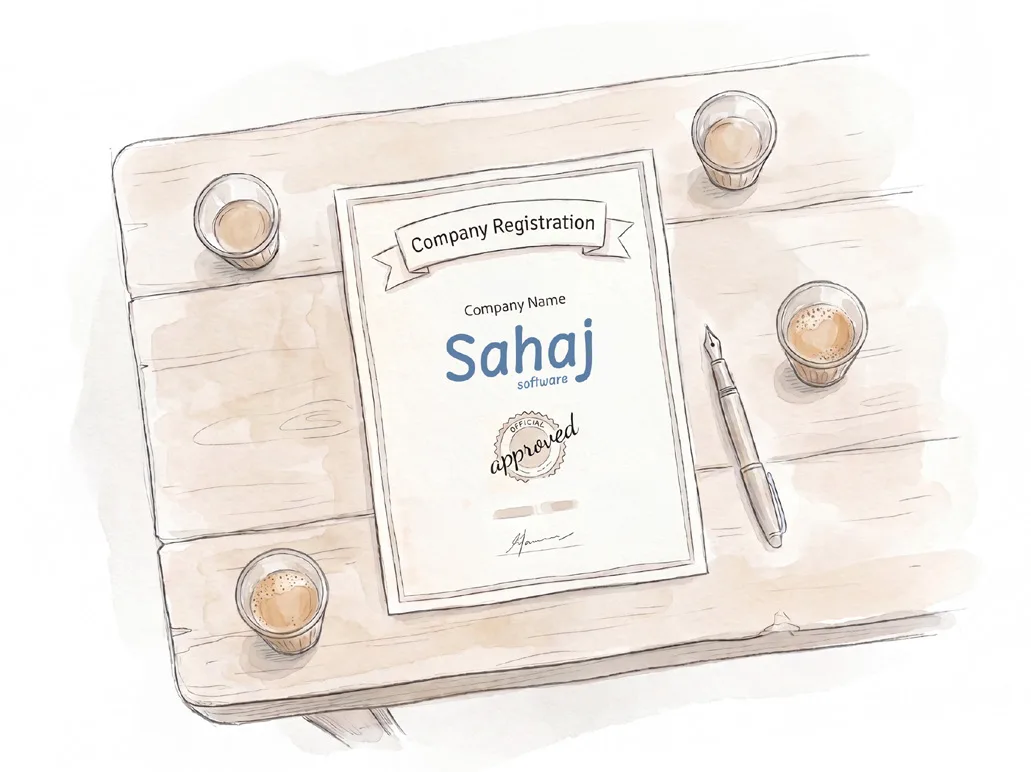
Armed with a name for our company—Sahaj—we started looking for someone who could help us with the statutory setup and make it a legal business entity.
There are many people who supported us in our formative years and one of them is Vikas, who runs a financial accounting firm in Bengaluru. He agreed to handle the company registration and related formalities for us for a nominal fee.
Just then, we ran into our first hurdle in the objective of doing everything ethically and with no wrongdoing.
Chapter 04
Mutual Respect
As I mentioned before, we had adopted a ‘no roles, no grades’ philosophy in Sahaj—everyone is called a Solution Consultant, given that we all worked toward devising optimal solutions for our clients. But it wasn’t from day one that we called our people solution consultants. There were multiple ideas floating around: we were going to be ‘advisors’ to our clients or ‘partners’ to them. There were some other names we toyed with. And then we looked more deeply at it. We came up with Solution Consultant because we were going to put ourselves in the client’s shoes, understand their pain points, and then design a solution to their problems. Besides the technical skills, a solution consultant was required to have good communication and behavioral skills and the mindset of a consulting professional. Which is why a certain pride came to be associated with being a solution consultant at Sahaj.
[...]
All of this—getting deep under the client’s skin, wielding great communication and influencing skills, and building the solution with top-notch technical prowess—is not easy.
Chapter 05
Curiosity and Sharing
In our very first two years, we made profits beyond our expectations. But rather than divvy it up among the founders alone—standard practice for startups given that it is the founders who take the risk—we once again challenged the status quo.
We were not comfortable with keeping all the money for ourselves; we wanted to reward the 40-odd people who had trusted us and slogged along with us to build this company. That was also part of reducing exploitation according to our chosen value system.
So we introduced profit-sharing to make sure all Sahajeevis got a fair share of profits Sahaj made. And this was, of course, in addition to their salaries and ESOPs.
When we announced this to our people, they said, “Wow, this is really walking the talk!”
Chapter 13
Craftsmanship
Freedom and empowerment can mean different things to different people. For us at Sahaj, they have led to a string of innovations crafted by Sahajeevis—often without any involvement of the founders.
I tend to think of it like the branches of a banyan finding their way around and giving shape, structure, and stability to its emerging, beautiful canopy.
The real proof of the experiment called Sahaj was when people started taking a lot of initiatives and responsibilities on their own—and used that freedom to come up with all sorts of creative ideas. And not only that, handcraft those budding ideas into flowering innovations.
Let me share a few such innovations—client-facing as well as internal—at Sahaj over the years.
This book is much more than a historical account of our company’s journey; it is a testament to the collective effort, passion, and profound belief that countless individuals invested in our vision. This book is the chronicle of Sahaj’s growth—from a seed of an idea planted in a small office to the vast, encompassing canopy providing shade and sustenance to our entire community today. My gratitude extends to every single person who played a part in making this monumental endeavor, both the company and the telling of its story, possible. Biggest thanks to the anchor and the foundation (the deep roots)—our families. The Sahaj community is strong and thriving not only because of the folks in Sahaj but, equally importantly, because of our families. Each and every Sahajeevi’s family has contributed in building this community. I thank everyone in the Sahaj extended family from the bottom of my heart.
My first and deepest thanks must go to my guru, my mentor, my best friend, my motivation—Nidhi. I proudly say I am her husband. Your support has been the unwavering anchor that stabilized me through every storm, every late night spent planning, and every gut-wrenching, critical decision required to build this company. Your endless patience, your resilient belief in the company’s often-abstract mission, and, most importantly, your absolute, unqualified faith in me provided the essential, non-negotiable foundation upon which everything else was built. You did not just stand by me; you stood with me, shouldering the emotional weight of this enterprise. You unassumingly asked simple questions that made me think about anything and everything. There were times when I was low, depressed, especially after the U.S. failure, but you pulled me back. Thank you for always being there.
And to my amazing children, Arnav and Saanjh, thank you for being the support and questioning things from a new-world perspective. The arguments and the discussions opened my mind to a different and new way of thinking. Those dinner discussions always acted as a validation point and didn’t let me slip the guard rails. And thanks for being part of this madness of mine and never complaining or making me feel guilty for my stupid decisions of moving countries mid-way without thinking about your future.
To the families of our co-founders—you are the unsung, often invisible heroes of our success story.
Upma for being Nitin’s pillar of support. I am sure moving cities and countries was not easy, but you were there for his support all the time. And not only that, you sacrificed your career to move with Nitin to the U.K.; it’s not easy. In the process, you compensated for Nitin’s absence as he was busy with Sahaj, and spent all the time with Mridul. I am sure, Mridul, it was not easy for you to shift schools and pick up new culture when you moved to the U.K., but you never complained to your dad, Nitin, and made it look easy. Aunty (Nitin’s mother) for traveling and staying all alone when Nitin moved to the U.K. It’s not easy to live and manage things on your own, but you never let Nitin’s resolve weaken.
To Veni for being there with Sunder. Amongst all the founders, Sunder has traveled the most both within India and globally. Not only that, he has been the one who has been at the forefront of all social dinners with clients and prospects all the time, and all this came at the cost of family. Veni, you never complained; in fact, on the contrary, you gave enough freedom to Sunder to go and do the right thing for Sahaj. To Nandu and Geetika, for allowing Sunder to steal your time and give it to us at Sahaj.
Like the banyan tree’s prop roots that descend from the branches to become supportive trunks themselves, your sacrifices and consistent, selfless encouragement were absolutely vital to our stability.
Building a company of this scale requires profound sacrifices, not just in terms of time and energy, but in shared family moments, forgotten holidays, and postponed plans. Your willingness to share your partners and parents with this all-consuming, ambitious project made our professional partnership stronger, more resilient, and fundamentally rooted in mutual respect that extends far beyond the boardroom. This company is a collective, generational victory, and we owe a massive, enduring debt of gratitude to the entire co-founder extended family for their profound patience.
This book required a different, yet equally intense, kind of belief—the conviction that our story was worth telling, and the exceptional skill required to shape a decade of chaos into a clear, compelling narrative.
A truly special and heartfelt thank you goes to my friend Sanjay Gupta, the talented writer who undertook the immense and complex task of capturing our chaotic, exhilarating, and deeply personal narrative. You did far more than just plan, transcribe, and execute the interviews; you seamlessly translated my authentic voice, my core vision, and the complex, nuanced history of our organization into a clear, cohesive, and genuinely compelling chronicle. Your dedication to preserving the core authenticity and unvarnished truth of our journey on every single page was nothing short of invaluable, elevating this from a mere history to a genuine narrative. In fact, many times your view on how we should approach a certain chapter was quite innovative and involved. You were always vested and committed to the book, thanks for bringing this out
for us.
To the unsung hero, Kshitij Sawant. This book would have remained, indefinitely, a promising idea scribbled in a dusty notebook without your strategic insight, your organizational genius, and your relentless, uncompromising drive. Thank you for championing this project from the very moment it was proposed, moving it from a simple, abstract concept to a fully realized, globally published reality. Your ability to marshal diverse resources, manage the staggeringly complex timelines, and keep the larger, inspiring vision in sharp focus was absolutely instrumental in bringing this work to a meaningful fruition and, most importantly, for encouraging and pushing me to move ahead with this initiative.
Finally, my deepest and most sincere appreciation goes to the large number of individuals, the former and current Sahajeevis and our partners. Thanks for giving the most valued commodity: your time and deeply personal memories. Your candid perspectives, honest insights, and willingness to recount both the exhilarating highs and the unavoidable, painful lows provided the necessary depth, texture, and emotional richness required to truly tell the complete, three-dimensional tale of Sahaj. Thank you for trusting us with your experiences, for opening up your past, and for helping us paint a comprehensive, vibrant, and ultimately truthful picture of this incredible journey.
To Sharath, Srikanth, Nandish, in spite of not being part of Sahaj anymore, you guys were able to find time from your busy schedules and spend time with us; walking down the memory lane with you was really nice. Thanks for reliving those moments. To Vikas (our most trusted financial advisor and auditor), thanks for spending time and talking about your belief in us and for supporting us all throughout.
To my friends in Sahaj (in alphabetical order) Anay, Anil, Arun, Deepa, Dileep, Jaya, Jeff, Karun, KC, Kshitij, Manish, Nita, Dr. Oshin, Praveen, Priyank, Priyanka, Dr. Ravindra Babu, Sudharshan Ravi, and Veda. Thanks much for spending time and thinking about those small little things and instances that make Sahaj simple and unique.
This book is a shared history, a collaborative narrative, and in the spirit of that enduring partnership, it belongs to all of us who built, believed in, and contributed to Sahaj in ways large and small.
Origins
The purpose, the community, and the belonging that built everything else.
Origins · Chapter 01
Challenging the Status Quo
If a tree falls in a forest and no one is around to hear it, does it make a sound?
Now, let’s tweak this thought experiment: If a tree is planted and nurtured, what kind of impact can it create?
In our threatened environment where trees are being felled like ninepins, it is a critical question to ponder.
Trees are among the oldest living creatures on our planet. They were doing just fine before humans appeared on the scene. In all likelihood, they will go on till eternity if homo sapiens were to vanish from the face of the earth.
But what if there were to be no trees tomorrow?
The world will fall apart in the absence of these brown-green sentinels of nature. Before long, there will be no creatures whose life they sustain—including humans.
And that is why, in our precarious times, trees are not merely the best symbol of nature. They are our best symbol of hope.
Among the trees, there’s a species that holds a distinctive place for its mighty appearance and beneficial significance. Ficus benghalensis. The banyan tree.
As per Hindu beliefs going back thousands of years,
once there was a great churning of the ocean called Samudra Manthan. Gods and demons formed an alliance and churned the waters using a giant serpent wound around Mount Mandara, a sacred mountain. Besides the much-coveted nectar of immortality, it yielded several other bounties, one of which was the wish-fulfilling tree, Kalpavriksh (also known as Kalpa Taru or Surataru).
The banyan tree, popularly called bargad in India’s Hindi heartland, is said to be a living embodiment of Kalpavriksh.
But then, one need not go so far back in time to appreciate the real magic of these magnificent beings.
There are many great banyan trees in India that inspire awe and attract tens of thousands of tourists each year. The most notable include Thimmamma Marrimanu in Andhra Pradesh, the Great Banyan of Kolkata, and Dodda Alada Mara, near Bengaluru in Karnataka.
These giant wonders are hundreds of years old, each looking like a forest in itself. The spread of their canopies through additional trunks made of aerial prop-roots is incredibly vast. It is said that when Alexander came to India in 326 B.C.E., he came across a banyan that could shelter a few thousand of his soldiers.
Even today, across the length and breadth of India, you can see the banyan sheltering and supporting a community of birds, animals, and human beings.
The banyan has traditionally been a hub of activity in a large number of India’s six-plus lakh villages. A sort of cultural melting pot where people would gather to exchange news, have a chai or hookah, or conduct some business.
From women drawing water from a nearby well, to hairdressers applying lather on the faces of young men wanting to get a clean shave, to traders selling stocks, the banyan has seen it all over the centuries.
It is interesting to know how the banyan came to be named and its intertwined connection with one of the world’s largest and oldest stock exchanges.
There’s a trading community in India hailing from the western states of Gujarat and Rajasthan. This community, which also migrated to several other places in the country as it grew, is known as ‘bania’—a word that derives from the Sanskrit ‘vanija,’ meaning trader or merchant. In the early days, most people belonging to this tribe, called banias, would do business in the shade of a bargad. Over time, the tree itself came to be associated closely with banias. Thus, the banyan.
The Bombay Stock Exchange (BSE) is one of the largest in
the world and the oldest in Asia. But long before it started operating out of the current 29-story Phiroze Jeejeebhoy Towers, it had a humble origin in the 1850s, when five brokers—four Gujarati banias and one Parsi—started trading shares under a banyan tree near the Town Hall in Bombay (now Mumbai).
There were no fancy electronic terminals for trading then, just some bits of chalk and voices that rang a bit louder than usual.
Over time, they were joined by other traders and formed what was initially called the Native Share & Stock Brokers Association.
Now, thousands of traders are electronically linked to the BSE, making split-second trade decisions for millions of investors.
That original bargad is gone. In a nearby place called the Horniman Circle, there now stands another banyan as a symbolic reminder.
In the fast-urbanizing landscape of India, the villages are being converted into towns, towns into cities, and cities into metropolises.
Alongside, the local community-based businesses are growing into ambitious enterprises, housed not under banyans but in glass and concrete skyscrapers.
But even in this rush toward modernity, you can spot a banyan here or a peepal there, offering their cool shade and a shelter to creatures other than humans—pigeons, ants, squirrels and many other lifeforms who continue to
go about looking for food along the branches and leaves, chomping on figs and cavorting with each other (the peepal is a sacred relative of the banyan).
In the world of business, people often draw analogies from the trees. Entrepreneurs and venture capitalists talk of ‘seed’ funding. Brick and mortar banks and other organizations open up new ‘branches.’ And many brands play up their strong origins or ‘roots.’
And yet, despite all this symbolism, the way companies are started and run is quite unlike how trees are planted, nurtured, and grown.
There is a single operating principle that drives the existence and thriving of most companies in the world: Maximization of profits. On the face of it, there’s nothing wrong with it. After all, making profits is the reason why someone starts a company in the first place. But as one goes about ratcheting up the ‘maximization’ part, all evil can break loose—and it does break loose as we have seen happen across industries.
Chasing profits (at any cost) often leads to companies growing their top as well as bottom lines at speeds measured in quarterly results—and manipulating anything that may restrain that speed. In the process, they also put in place a corporate structure built to extract the maximum output from—to use an analogy from manufacturing—the three M’s: Man, Machine, and Material.
Before long, an elaborate hierarchy of workers, managers, and super-managers can be seen moving the corporate cogs and levers, day in and day out.
The result: the modern corporation becomes a money-
making organization with certain characteristics. If it’s a listed entity, it commits to operating in a manner that extracts the highest possible returns to its shareholders. If private, it works incessantly to enrich the owners. In either case, it ‘achieves success’ by hiring employees and providing them with ‘lucrative’ incentives involving salaries, loyalty bonuses, and movement up the so-called corporate ladder.
The market landscape in a typical industry is dotted with a number of such profit-driven companies that compete fiercely with each other or rivals from other geographies. Their employees reflect the aggressive ambitions of their employers, doing everything in their power to reach higher and higher rungs on the corporate ladder—within the same organization or, often, by switching jobs to speed up their upward mobility.
This whole enterprise of people working ferociously in aggressive companies myopically focused on short-term profits has become a common spectacle. It has become the norm, the SOP (Standard Operating Procedure) of how companies are run.
Let me take the example of the software services industry to illustrate what’s wrong with this model.
The global software services boom happened on the back of labor arbitrage. A number of software export firms sprang up in the 1970s and 80s that hired engineering graduates to work on application development and maintenance projects, mostly overseas. These projects would have cost much more for the local companies if they were to hire people in those countries. The software firms grew their business by paying the employees relatively less and pocketing the difference as profits. It seemed like a win-win-win situation for the clients, the
services firms, and the graduates (who were only too happy to get a chance to travel and work abroad). The Millennium Bug opportunity and the Internet boom further accelerated this business. By the 2010s, the industry grew into a multi-billion-dollar juggernaut.
Over time, the software services companies kept pivoting to different types of projects, besides ‘moving up the value chain’ by doing work that paid better than low-level code maintenance. This included consulting, testing, and product engineering, among others. But the basic model and approach remained the same: hire more people to serve more projects and clients—the volume play.
To serve their growing clientele in multiple countries, the companies put in place elaborate, often complex, hierarchical structures of developers, testers, supervisors, managers, sector or practice heads, and so on. More and more cogs to keep the wheel turning.
The complexity seeped into everything they did—from hiring people to running their organizations to serving clients to delivering projects.
It took a while before the dirty little secret of how the software services industry operated was out. A telltale sign began to come up in the earnings statements and balance sheets of software bigwigs - ‘repeat business.’ This implied high profitability for investors in these companies. Most clients, however, were on the receiving end because they were in a ‘vendor lock-in’ situation. To investors, it exuded high profitability; to clients and industry observers, it reeked of the services industry’s equivalent of vendor lock-in.
What this essentially meant was that, once a software major got a contract from a large customer, their
engagement with that customer didn’t usually end within the stipulated time. It got extended and expanded—with more people and more work added on top of what was initially agreed upon.
Superficially, nothing seemed amiss. But dig deeper and you realize how exploitative the whole system had become. To serve the clients, the companies set up an elaborate and often complicated hierarchy of managers, developers, analysts, testers and others—often in a way that created ‘knowledge islands’ within their cadre. Clients were forced to keep extending or renewing the services contracts as an ‘insurance policy’ against possible disruption to their business.
At one end, people working in the software industry came to be exploited or manipulated through the lure of foreign gigs, false promises in an artificially-erected hierarchy, and lack of transparency and trust. Worst of all, people began to be treated as if they were machines.
At the other, client end, companies got exploited by being stuck with a software company for prolonged durations— often paying through the nose for fear of causing any disruption to their business should the outsourced tech team vanish.
So, while business was booming for the software companies, who proudly quoted repeat business rates of 80-90% and above, their clients were often a distressed lot. Millions of dollars got wasted on delayed or unsuccessful projects, which were more often than not complex, monolithic solutions requiring an equally complex pyramid of coders and managers to run and maintain. Customers didn’t have a choice other than sticking with one service firm or another from a provider pool that looked eerily homogeneous.
The huge size and apparent success belied the simmering troubles in the software services industry—among clients who were getting disappointed as well as employees who were feeling frustrated or stifled.
Customers wanted quicker, efficient solutions to their problems—what they often got was spaghetti code, project and budget overruns, and, in worst cases, failed implementations.
Employees wanted exciting, well-paying career paths with organizations they could proudly belong to—what they got was manipulation, jobs that felt like running on hamster wheels, and intellectual malnourishment, besides no clear answers to their probing queries.
All this raises some fundamental questions: Why do companies hide things and manipulate people? Why should making profits trump everything else? Why is there a glaring lack of trust?
More importantly, Can something be done about it?
Is it possible to start and grow a company that’s non-exploitative, open, and welcoming for everyone who comes in its contact?
To explore these questions—and some possible answers—let me take you through an experiment called Sahaj.
It all began in 2014.
Origins · Chapter 02
Keeping it Simple
“Toh phir kya socha? (So, what have you thought?)” Sunder asked me.
“What do you mean, kya socha!” I said, rubbing the last remnants of sleep out of my eyes.
“Arrey bhai, about starting our own business!” he persisted. (‘Arrey bhai’ is colloquial Hindi for ‘Dude’ or ‘Hey bro’)
I looked at him blankly, trying to concentrate. We were seated next to each other on a flight from Pune to Bengaluru and the plane had just touched down.
It was the jerking motion of the aircraft, not Sunder’s query, that brought me back to the world of reality. Obviously, it took me a while to register what the heck Sunder was talking about. The January cold did nothing to warm things up for a person like me who would doze off on whatever moved, be it a car, bus, train, or anything with wings.
Then I remembered it. He had suggested starting our own business, given that I had resigned and he had decided to quit from one of the global software services firms. We were technically still employed and were returning after attending the inauguration of their Pune center.
I had protested to Sunder that we were in our forties and didn’t stand a chance among so many young lads who
were starting product companies left, right, and center. We hardly had any hustle left in us.
“We have our EMIs to pay, so we’ll find another job,” was my initial response.
But Sunder went on with his pitch like a tenacious bull even as the plane was taxiing. To get him off my back, I had said, “Let me think” and fell asleep, my old habit kicking in the moment we were up in the air.
Now, as our plane came to a halt in the middle of the night, I was in no mood to respond; besides, we were in a hurry to get off and go home. Our discussion could wait.
The wait turned out to be short. Next morning, we both met at the chai tapari, a local tea joint behind our office. Sunder was having a smoke and I was sipping tea as usual.
In no time, he started off again, “Let’s start our company, it’s not that difficult.” Realizing that he’s not going to give up easily, I called another senior colleague, Mr. B., to come down from the office and join us for a walk (His real name is Rohit Bansal but everyone calls him Mr. B.). Along with us, he had also decided to leave the firm. When a bunch of people leave the same company around the same time, they become pallier than ever.
Now, the three of us were walking on this road near a plush hotel, close to our office, and I told Mr. B. the reason for calling him: “Sunder has been after me since yesterday to start our own company.”
Hearing this, Mr. B. instinctively jumped to the other side of the road—as if to create a barrier between him and two crazy minds. “You guys have gone nuts!” he shouted from a distance. “Starting a company is no joke in India— you’ll lose whatever hair remain on your head.”
In a somber manner typical of Mr. B., he advised us to go find suitable jobs and carry on with life.
I laughed them both back to work, thinking the matter ended there.
It didn’t.
Friday, same week, Sunder and I got a call from Mr. B. “Let’s meet tomorrow afternoon at Costa Coffee, Koramangala.”
We decided to meet at 2 p.m. and Sunder and I reached on time. Mr. B. reached five minutes later, his old dilapidated laptop in hands. He walked in and came straight to the point, “Here, guys, I have it all mapped out—we’ll break even in 3 years. This is the business plan, take a look at this Excel sheet.”
“What business plan? What are you talking about?” Sunder and I said in unison.
“You guys were talking about starting a business a couple of days back, no?” Mr. B. said, sounding surprised himself.
In any case, we took a look at the spreadsheet—and trashed it almost instantly.
But something in us had stirred. We wanted to start our own company, all right. “Let’s meet over the next few weeks to decide what we want to do and why,” we said as we left the café.
The next 12 weeks saw us meet multiple times at the buzzing coffee shops of Koramangala, much like what the startup lore of Bengaluru is famous for. Only, instead of young Ivy League grads with VC-funded dreams, we were a bunch of dyed-in-the-wool pros coming from the traditional software services background.
Two more colleagues from the software services company where we worked, Nitin from their Gurgaon office and Bala from Chennai, joined us along the way as co-founders in our as-yet-unnamed, as-yet-unformed ‘startup’. As Sunder, Mr B., and I were going through
our conversations, Nitin was going through his own disillusionment with the software industry and having debates around it with a few of his friends. He happened to travel to the U.S. in January 2014 and used the flight time to make up his mind: by the time he came back he was quite clear about quitting his job and figuring out something on his own, though he was confused whether to take the services path or go the product route. He called me the very next morning and asked about our plans. My conversation with him quickly convinced him to join us in our startup discussions.
Besides the cafes, we sometimes met in the hotel lobby where Nitin and Bala would happen to stay during their visits to Bengaluru. Or we would pick each other’s brains over video calls.
Our brains were on overdrive.
Why do we want to start a company?
There must be a strong reason behind whatever we choose to do?
Should it be a product company or a consulting firm?
How will it be different?
The questions came thick and fast to our minds. After a few rounds of brainstorming, we decided to put our thoughts on sticky notes.
Since we were all good at abstracting things, there soon emerged some coherent thoughts out of that exercise.
First and foremost, we wanted to start a company from the people’s perspective—a company that would be run ethically and lawfully, ensuring that we went to bed peacefully at night.
We also wanted transparency and openness in whatever we chose to do. And yes, there would be no room for Machiavellian politics.
As we sifted through the little yellow bits of paper overflowing with our thoughts and ideas, two words jumped out at us as if in big bold font.
“Reduce Exploitation.”
These words mattered more than anything to all of us. Having come from the software services background, we had seen from close quarters how the industry morphed into a system of exploitation and manipulation—of customers as well as employees.
For a moment, we were silent and resolved never to perpetuate such practices in our own company. We were ready to hold ourselves to much higher standards than what was considered the norm in the industry.
When we realized this, it was like an Aha! moment for the five of us. We were going to build a people-centric company that would solve the customer’s core business problems. Not only that, instead of clinging to clients like limpets, we would quickly take them to a place where they were comfortable maintaining the solution themselves.
Initially, we also toyed with the idea of starting a product company. But that would have meant that funding from sources such as VCs was a necessity because of the longer gestation periods for product firms. And we all knew very well that, once we zero-in on the idea of reducing exploitation for our business, no VC would touch it (they would rather we maximized gains, wouldn’t they?)
So we rejected the product ideas we had.
For us, the purpose of starting a company was more important than what the company would do.
And then we thought, why not use our own savings and our collective services and consulting experience of over 100 years to start an entirely different kind of organization?
The idea of reducing exploitation—of clients by avoiding practices that took them for a ride and of people working with us—was like a fresh breeze soothing tired travelers under a tree.
We were about to challenge the status quo in an industry that few dared to change.
The genesis of this idea and the act of giving it shape remind me of children playing and learning in a Montessori environment. In that system, children of different age groups learn from each other and they are at the top of their creativity. They’ll make the best use of what they are given to play and learn. They are not unlike the soft mud they play with: even as they make innovative shapes out of the mud, they are themselves molded into
well-rounded, creative human beings.
In that creative, spontaneous environment, nobody judges their capabilities and there are no limits to what their tiny hands and expansive minds can achieve. All play is learning and all learning is play. And there are no losers because everyone is a winner.
It’s only when they get into formal school that their minds start getting corrupted with thoughts and instructions imposed by adults, often with an uncalled-for authority. Curious, inquisitive children end up getting bombarded with “Don’t do that!” or “You can only do this.”
The adult world, teachers and parents alike, goes all out to curb the creative instincts and non-conforming behavior of children—forcing them to comply, to obey commands, to ‘sit properly.’ Stopping only when they see the children grow into compliant, ‘disciplined’, somewhat-timid beings that are more like their own mirror images.
No wonder ‘the world of adults’ is so miserable, often reminiscing about—ironically—the ‘joyous kingdom of children’!
So, when we were starting up, our thoughts were like: Can we create a company where people have the freedom to do what they want and what they deem right? To act with the freedom with which they were born—rather than get restrained by the usual drudgery of billing more and more or building bigger teams? Can they be, like children in a Montessori, free with their creativity? And not only that, can we do all of this in a totally transparent and open manner?
In a free environment, maybe they will do what they think is right and come out as better professionals.
In simple terms, can we just let people be?
That, to us, was what reducing exploitation of people felt like.
And the way to do that was to empower people with data and information, to be completely transparent about the revenue, margins, expenses and all other operational aspects of running a business—so that they are educated about it and make informed decisions for themselves. They should feel like business owners, not employees who walk in to work for someone.
That’s why even before we named our company, we decided not to have the typical employer-employee construct. We were going to have a ‘no roles, no grades’ philosophy.
On the client side, too, we decided to apply the principle of reducing exploitation by operating in a manner that was in direct contrast to how most software services firms did business. We said that we would build the solution for a client in the fastest possible time with the smallest of teams and in the simplest of ways. Not only that, rather than latch on to the clients for as long as possible, we would make a conscious effort to get out fast: build a simple solution, enable their team or the incumbent partner, and hand it over to them—that was going to be our mantra.
When we were planning our startup, the success criteria
for a typical software company were: How big the project was, how big was the team working on it, how long they could stay on in that project and, ultimately, how much money they could make from that customer.
Us? We just wanted to get out in the optimum time so that we could move on to solving other challenges for other customers. Solving business problems quickly and efficiently was what excited us. Cost optimization for clients, not profit maximization for us, was what brought sparks to our eyes.
We were determined to go against the grain and turn software consulting as it existed on its head.
I remember all of us getting excited like children with all these thoughts bubbling up in our heads. On occasions, we literally ran home and talked to our families about what we were up to.
The next big step in our journey was to pick a name for our venture. We discussed multiple options among ourselves and with our friends and families.
We all agreed on one thing: that we would keep an Indian name to reflect our Indian identity and heritage.
We played around with several Indian-sounding names. There was one we almost finalized: Gyati (with Sanskrit roots, it broadly denotes something which is knowledge-based).
But then someone objected, “Hey, shouldn’t our name be
simple, given that our aim is to solve complex problems with simplicity and ease?”
“That’s true. Let’s avoid complexity in our name as well and keep it as simple as possible,” I concurred.
Almost instantaneously and spontaneously, it was Mr. B. who remarked, “Simple matlab Sahaj.” (Simple means Sahaj.)
And we all shouted in sync: “Wow, let’s make it Sahaj!”
Sahaj fit snugly with what we were setting out to do and it resonated well with all five of us.
Origins · Chapter 03
A Big Win - Trust
It was March 2014 and Sunder, Mr. B., and I were out of jobs. Bala and Nitin were to join us from May.
Armed with a name for our company—Sahaj—we started looking for someone who could help us with the statutory setup and make it a legal business entity.
There are many people who supported us in our formative years and one of them is Vikas, who runs a financial accounting firm in Bengaluru. He agreed to handle the company registration and related formalities for us for a nominal fee.
Just then, we ran into our first hurdle in the objective of doing everything ethically and with no wrongdoing.
It had something to do with how several government departments, which included the registrar’s office, were supposed to work in India (files moved or got approved only after serious struggles).
Now, we had clearly told Vikas that we wouldn’t be paying anything over and above the regular fee, come what may. We asked him to apply for registration with the stipulated fee of about ₹5 lakh and see what happens.
Predictably, our application was rejected. While the rejection was swift, the money would only be refunded to us after two or three months. At our insistence, Vikas applied again, with another ₹5 lakh deposited with the Registrar of Companies. Again, rejection—and another
precious ₹5 lakh stuck in government coffers. Our bootstrapped corpus was already beginning to look tiny.
What should we do now? The question loomed large on us.
“Let’s give it one more try,” we told Vikas. He threw his hands up in the air but complied with our request nonetheless. We were dogged in our pursuit of getting things off the ground without anything weighing down on our conscience.
We waited.
This time around, the application came through. Vikas was incredulous. He hadn’t seen anything like this in his prior experience. We heaved a sigh of relief.
We were officially Sahaj.
This was the first litmus test of staying true to our purpose and we didn’t budge—even though we came close to a point of running out of money.
So far, so good. But more teething trouble lay ahead.
A few weeks earlier when we were discussing business plans, Sunder had said that he was in touch with many folks in his network and could get “at least six companies to sign deals” with us.
And while I had offered to run operations, Mr. B. had pitched in for recruitment. “There are about 40-odd people in my network who follow me and would be more than willing to join us in our venture,” he had said, a note of optimism in his voice.
After our company was registered, they both went about checking with their contacts—and were jolted with a rude reality shock. Not a single one of those prospective people or clients materialized. The prospects made all sorts of excuses, ranging from the ridiculous to the unbelievable, but the fact of the matter was that we had drawn a blank with them.
We were dejected, of course, but we were determined to press ahead.
We followed the simple strategy of talking to more people about our plans and getting as many referrals as possible. In fact the singular strategy that we came up with was to somehow find our first client through our networks and then stay true to our value of delivering quality solutions to them. We were hopeful if we did this the clients would refer us to more companies in their network.
Over the next few weeks, we managed to hire four people and got to work on some projects through our connections.
Among the first to join us were Sharath and Raj*, both of them known to us through our past jobs. Given that they were senior specialists—Sharath was a fantastic DevOps and cloud architecture guy and Raj was an automation/ QA pro—we could hardly afford them at the time and, more importantly, we didn’t have an immediate need for them. It must have taken a leap of faith for them to say that they were willing to come on board without a salary for some time. But we had kept the no-salary-for-a-while part for founders and insisted that we must pay them salaries, even if not at their market rates initially. (We would, of course, more than make up for that later on.)
We also hired two devs, Shweta and Vikas. A little later, we made our first hire outside Bengaluru: Shashank, a senior dev in Gurugram.
Shashank happened to join us just when we urgently needed a senior developer matching his skills.
Now, Mr. B., as part of our outreach to prospects, was talking to one of his trusted contacts in the U.S. who happily agreed to give us a week’s work for a few thousand dollars. There was one hitch, though—the job required expertise in Ruby on Rails, a web application framework.
None of us had it at that time.
And that’s when Lady Luck smiled on us, by bringing Shashank into our fold.
There’s another twist in this tale: Since we didn’t have an office in Delhi NCR, Shashank agreed to work on
* name not disclosed for confidentiality reasons 33 this project from a Starbucks café. And he finished and delivered it on time. (We didn’t ask him how many coffees he ended up consuming!)
It was a sweet little win and we celebrated it with a dinner.
After our little bit of success in the U.S., Mr. B.’s connections in mission-driven organizations came in handy. An Australia-based startup wanted to make a community car-sharing app for mobiles—on iOS as well as Android. We agreed to work within their limited budget and said we would deliver the project in three months, in keeping with our newfound philosophy of quick delivery. The client jumped at it and we were on.
Once more, however, we were running ahead of ourselves: no one in our team had done mobile development before. But this time, instead of looking for a new hire, we decided to pull up our socks and take it as a challenge.
Vikas and Shweta dived headlong into it, learning the two mobile platforms and quickly applying their knowledge to the project at hand. Sharath helped them in the effort quite a bit.
We all slogged to meet our self-imposed deadline—and managed to roll out the app not in three but five months. What mattered more than slipping on the deadline was that the client was very happy with the final outcome. Besides, we didn’t bill them for the extra time we took. Unfortunately, we didn’t make any money on the project but it served as a good learning experience for us.
Our first big commercial success was an opportunity we were quick to capitalize on. Prabhakar, one of my friends who was the CEO of a publishing company in Chennai, was in the process of acquiring a couple of companies in the U.K. He asked me to go to the U.K. with him and sit in on his meetings with SGS and GPS (the companies that he was acquiring). The idea was to help him assess their product platforms. So I went there, attended the meetings, and was shown around their offices.
Later, I told Prabhakar that while the people seemed good, he would need to get a better grip on their code base if he really wanted to build on their platforms. For this, Sahaj could send two of our people to the U.K. for a few days to assess the platforms and submit a report.
Prabhakar agreed and we sent Nitin (who had joined us by that time) and Shashank to study the two platforms. Their assessment revealed that the platforms were not stable and the code base required refactoring—restructuring or rewriting the code to make it cleaner, simpler, and better. We gave Prabhakar an effort estimate and offered to do it in three to four months.
That is also how we got our entry into the U.K. market. From a geographical expansion viewpoint, this would turn out to be a great move for Sahaj.
Let me tell you a little bit about where we started. Unlike Silicon Valley folklore of companies starting out of garages, our first office was not really a garage. But it did have the appearance of one: it had a roll-up shutter for an office gate. One of us would literally haul it up each morning.
I managed to get a small place to serve as our first office.
It was in a building in Bengaluru’s HSR Layout area. Owned by a very nice and humble elderly gentleman who lived on its third floor, the building’s ground floor was a hardware shop. We rented out its second floor that could seat a dozen or so people.
Like a typical bootstrapped startup, we squeezed costs where we could. So we had the walls painted and got a couple of meeting rooms created as economically as we could—the whole office setup cost us less than ₹50,000.
In the first few days, something happened that laid the groundwork for our ‘no roles, no grades’ approach to organization building.
We had ordered some tables and chairs that needed assembling. Plus, there were curtains lying in the office, waiting to be installed. One morning as I came in, I saw Sharath and Manish (a senior UX designer who had just joined) assembling furniture and drilling holes for curtains. To save us money, these two industry pros—who would’ve been easily drawing ₹30-40 lakh in annual salaries in their previous companies—thought nothing of rolling up their sleeves and getting down to doing it themselves.
Sharath even brought a drilling machine, and a printer and a router from his home to get us up and running as a functional office.
In those moments, I knew in my heart that nothing would be out of bounds for people in Sahaj.
We would move into a bigger place within a year, but it was in the HSR Layout office we got one of our biggest
early wins—a non-profit organization started by one of India’s most celebrated tech honchos and his wife.
Started the same year we set up Sahaj, the organization wanted to revolutionize education for school-going children. As a part of their initiative, they wanted to build a platform that would use gaming and machine learning to level up children on their skills in basic literacy and numeracy.
This organization was on the lookout for vendors and two of their key executives happened to talk to Mr. B. They both came to visit our HSR Layout office and, following that, invited us to their office in Koramangala.
Mr. B. and I were both nervous as we entered their elegantly designed office and I still remember parts of our conversation that went like this:
“They have tons of vendors to choose from. Why would they give the contract to us?” I said.
Mr. B. didn’t have an answer to that but he asked me, “What billing rate do you think we should quote?”
I recalled Sunder’s push to create a premium positioning for us in the market. “Look, if we are to bring in senior talent and do superlative work, we need to go for higher rates,” he would exhort us all. He was absolutely clear that we were not building a run-of-the-mill mass company but were instead bringing the best brains in the industry into our fold to solve some of the most challenging problems—something that could only be justifiably done at premium rates.
We stopped talking as we entered the meeting room. Hiding our nervousness and anxiety, we presented our case.
The two gentlemen listened intently to our pitch. And after quite a bit of deliberation, they agreed. “Great. Let’s sign the papers and get started,” one of them said.
We started right away. All of us were full of zeal and hope. We knew that we had proved our detractors wrong when they told us that, with our kind of idealism, we wouldn’t last more than a month or two.
But why did this non-profit with backing from big names in the industry choose us over so many other, more established firms? I think it was for a couple of reasons: One, they were a startup themselves and wanted to pick a nimble startup for the project. Two, they must have sensed the hunger and confidence in us and realized that we were going to put senior, highly capable people on the job instead of novices.
The non-profit would be a big client for us and it would get our full attention and focus.
There were smiles all around in our office when we broke the news.
Nitin led the effort with a lean team of three people. I remember him telling me about the grand vision of the client after one of their kick-off meetings. They wanted to build a platform that could impact the learning outcome for more than 100 million students in India—and run it with a relatively tiny 25-person operation! I think one of those present even let out a (barely audible) whistle at the boldness of their aim.
In addition to Sahaj, the organization also had some eminent technologists on their side, which made our job exciting as well as challenging. Besides tackling the scope and scale of the project, we had to grapple with questions
such as: What kind of pedagogy was required? What would be the learner prerequisites? How do you define the desired learning outcome for a particular group of students? How do you ensure privacy and security of the data captured?
The first thing we did for them was to set up a data platform that could capture or that could eventually become a place for gathering all the relevant data from everything that happened in the field, on the apps, in the systems, and then figure out how to make sense of all that data, how to map learner journeys—basically, how to make this platform deliver on their mission. And they had a go-live date that was barely a month away!
We worked hard and met the deadline, but we told them that we would evolve this platform as it began to scale from, say, 10,000 users to 100,000, then to a million and so on. This made sense because on the one hand, it allowed them to experiment and learn and feed it back into the system for improvement; and on the other, we could replace some of the tools and technologies with newer, more robust ones as we went about upgrading and scaling it.
Now, there came a particular challenge when we had just rolled out the first version of this platform—and the way we handled it cemented our relationship with this client for the long term. We were told that there was a data loss. What happened was that the data they were capturing from the field, including physical data and notes from schools, did not match with the numbers showing up in the system.
“How the hell did that happen?” was our team’s instinctive reaction. But without losing time, we looked deep not only in the data platform we had built but in their whole
system. We worked day and night that week and were able to nail the problem. And that was not all: we also told them what would potentially fix it (the problem wasn’t in our code).
From that moment on, we earned their trust and our relationship went on for three-plus years, in which we worked on several other projects for them, including parts of their mobile application and some software development kits (SDKs) to enable third-party integrations into their system.
I remember an occasion where we even refused some work from them, asking for it to be given to some other contractor who could do it more cost-effectively for them (we weren’t cheap and were mostly focused on tackling harder problems). They were incredulous and said, “Which vendor talks like that!”
Sahaj does. Right from day one, we have been determined to do right by our clients. The key to the success of winning the heart of this client (as indeed all our clients) is that we were able to understand their mission—and turn it into our mission.
This also proved that our strategy of attracting referrals was working. They referred us to many other organizations and we went on to work with them as well as their ecosystem on several challenging assignments for more than three years. Likewise, we ended up doing many more projects for Prabhakar (the publishing company CEO), and he, too, referred us to at least 4-5 new clients.
Origins · Chapter 04
Mutual Respect
As I mentioned before, we had adopted a ‘no roles, no grades’ philosophy in Sahaj—everyone is called a Solution Consultant, given that we all worked toward devising optimal solutions for our clients. But it wasn’t from day one that we called our people solution consultants. There were multiple ideas floating around: we were going to be ‘advisors’ to our clients or ‘partners’ to them. There were some other names we toyed with. And then we looked more deeply at it. We came up with Solution Consultant because we were going to put ourselves in the client’s shoes, understand their pain points, and then design a solution to their problems. Besides the technical skills, a solution consultant was required to have good communication and behavioral skills and the mindset of a consulting professional. Which is why a certain pride came to be associated with being a solution consultant at Sahaj.
The key was not to build revenue for Sahaj, but to truly solve the client’s problem, which may or may not need technology. The idea was that whenever we started out on a project with a client, we would think like them and do what was in their best interest. All of this—getting deep under the client’s skin, wielding great communication and influencing skills, and building the solution with top-notch technical prowess—is not easy. But that’s what makes a solution consultant at Sahaj: A consultant who is ready to learn new domains, constantly polish their soft skills, and thrive in ambiguity.
The next big move was to make our salaries open. Everyone would know everyone else’s salary; nothing was going to be hidden. This was a very radical step, almost unheard of in an industry known to keep remuneration under wraps. In fact, in the complex hierarchical structure of the IT services industry (as was the case in most other sectors I believe), the ‘hidden knowledge of salary’ was often used as a secret weapon to manipulate employees.
But keeping salaries open for everyone wasn’t going to be easy. And the way it unfolded makes for interesting reading.
“What is in the Founders folder on your drive?” the Curious One asked me one day.
“Oh, it contains details about everyone’s salary,” I told him.
“I want to see it,” the Curious One said.
“Why would you want that?” I counter-questioned, a bit startled at the odd request.
“Aren’t we supposed to be an open and transparent organization? If you can see the salaries, I should also be given access,” he reasoned.
“Hmm, baat to sahi hai!” In a way he was right and I promised to discuss it among the founders.
In our daily founder standup the next morning, I brought this up with Sunder, Mr. B., Bala, and Nitin.
“Why do we keep our salaries hidden?” I asked them.
“Well, that’s the norm!” was their chorus reply. “Only the managers and HR folks know the salaries. That’s how it is.”
“But why? Think about it?” I pressed on.
And then I proffered my own hypothesis. I told them it was because line managers or HR professionals wanted to exert implicit control over their employees. And the employees knew or felt somehow obligated to ‘be nice’ to them or to be in their good books—for their next appraisal or salary hike was going to be decided by them.
It was an unwritten, secretive, manipulative system in operation in almost all companies for as long as anyone could remember.
Obviously, upsetting the apple cart on such a fundamental aspect was bound to see objections and counter-points by the other founders. Among the arguments that were raised:
Who will join us once people know everyone in the company would know their salary?
Salary is a very personal thing and most people wouldn’t want it widely known.
There will be fights: Why is that guy getting 20 lakhs whereas I’m only drawing 15 lakhs for the same job?
Experienced pros from established firms like Infosys and Goldman Sachs would hesitate to join Sahaj.
Opening up salaries will create some sort of pecking order, which will be detrimental to our objective of having no hierarchies.
Our regular founder standups were usually for an hour or so. That day, it went on for more than three hours.
While there were some apprehensions and risks, we also dwelt on the positives. For instance, if we were to educate people on why someone is getting less than their peers, they might take that feedback about the differential in the right spirit and start working toward getting a higher salary. This should encourage them to ask the question: What can I do more or where else can I add value in Sahaj? Such motivation is likely to make them learn more and grow more.
It would make the leaders deciding the salaries a lot more accountable, remove any biases or prejudices, and, most importantly, pave the way to remove gender-based pay disparity.
At the end of our marathon standup, Mr. B., Nitin, and I were all for open salaries whereas Bala and Sunder were still skeptical.
We took the debate to everyone in the company. We were still in our first year and our total headcount stood at less than 20. Which meant we were a close-knit group and could afford to spend a lot of time discussing and debating on topics that mattered.
And Oh boy, we did end up spending weeks on open salaries!
What convinced most people about keeping our salaries open was an interesting game of guess-the-salary we played one fine day after this debate had kept us on the edge for a while.
I vividly remember that day, when a dozen of us were sitting in a conference room talking about something. Suddenly I had a flash of an idea.
“Chalo aaj ek game khelte hain! (Let’s play a game today),” I said. “We’ll put down some parameters on which people’s salaries are usually decided. And then, looking at those parameters, we’ll all guess each other’s salaries— and see who gets it right.”
This broke the monotony of the meeting and got people excited.
Someone got up and started listing down the parameters on a white board.
“Degrees,” a voice came.
“Number of years of experience,” someone said.
“Job description,” another shout.
We ended up with 13 or 14 parameters like that, including: type of work or projects done, exposure across various stakeholders, technical skills, behavioral or consulting skills, educational background, location or city, years of experience, and cultural alignment, among others.
Next, we asked everyone to guess the salary of the group one by one.
We had great fun doing that and the whole exercise took close to two hours. And guess what? Almost everyone in the room got the numbers right—with only 10% deviation from the actual salaries!
And I said, “There you go: each of you has just learned to be a hiring manager!”
After the guessing game, we continued addressing people’s questions and apprehensions about keeping the salaries open.
A majority of people had come round to the idea of sharing remuneration details with everyone in the organization but there were still a few who hemmed and hawed.
Our state of indecision went on like this for a couple of months.
And then, when I realized that the impasse could only be broken by trusting my instincts—and going by what most people had concurred on—I made the salaries file accessible to all.
I sent an email to everyone in Sahaj that from now on, we are one of the rare few organizations with open salaries.
It turned out we weren’t wrong in trusting people or believing in the principle of mutual respect. In our next appraisal cycle, most people asked for raises not for themselves but for their colleagues who they thought ought to be paid better for all the great work they were putting in.
Over the next five years or so, we would do a lot of salary corrections. And I’m happy to say that over 90% of those were driven not by people for themselves but for their fellow Sahajeevis (that’s how we came to call the people of Sahaj).
The first few months truly saw Sahaj’s open, transparent culture based on trust and respect evolve with an easy spontaneity reflected in our name.
Besides an egalitarian, non-hierarchical structure and salary transparency, we challenged the status quo in how most companies set their leave policies.
And this, too, came about as a result of some conversations among ourselves. Having open conversations about everything runs in our blood.
I was discussing the leave policy in keeping with the regulatory norms in the state of Karnataka with Vikas, our financial advisor. We looked at the number of mandatory holidays, paid leaves, carry-over leaves, etc.—just like any other business getting started and thinking of routine but necessary stuff.
During those days, one of our members happened to ask me, “Akash, do you ask someone before you go on leave?”
I said, “No, I don’t.”
“Why?”
“Because I’m a responsible person accountable for my job,” I said.
His next question: “And do you always stick to the stipulated number of leaves?”
“I don’t count them like that. I can take more or less than that, depending on how many I need,” I shrugged.
“Then I, or anyone in our company for that matter, should
also be able to pick and choose our leaves,” he said. The conversation got me thinking and I discussed it with my co-founders. We all debated the pros and cons of not putting a cap on the number of leaves one could take.
One major hitch we encountered was this: as an agile organization working in small teams of relatively senior professionals, unrestrained leaves could disrupt our delivery schedules. So we said that people could go on as many leaves as they want, provided they inform their team mates well in advance and someone agrees to stand in for them in their absence.
The idea was it would work more like how insurance works: we all pool in our leaves, and anyone who needs more would take it and others would make up for the gap. The point was that if we all acted responsibly and took accountability, then something basic but paradoxical in our consulting set up—unlimited leaves—would work really well for everyone.
Everyone supported the reasoning and that is how we rolled out unlimited leaves in Sahaj.
By the end of 2015, Sahaj had grown to about 40 people in two locations: Bengaluru and Chennai. And we were making decent profits—in fact, given that our opex was low and we were in the services business, we were profitable right from our third month of operations.
The time was ripe to take another set of bold, unconventional decisions.
One of the things we did right from the beginning was to ensure that the ownership of the company did not remain
confined to the five founders. We believed that those who joined and worked with Sahaj, in particular the early members who slogged and stayed the course with us, deserved to own a stake in the company. So we rolled out a stock ownership plan but it wasn’t like your usual ESOPs. In addition to the ESOPs typically given by companies as part of people’s salaries, we gave bonus stock regularly to Sahajeevis—month after month, year after year. These were given at the fair market valuation at the particular time and the proportion of such bonuses was kept relatively higher for the old timers—in order to adequately reward their commitment.
And we didn’t stop at that but kept evolving our ESOP. One problem with a typical ESOP is that people have to convert them into shares by paying the price for conversion if they want to retain the stock in the company when they leave. So they are not sure if the money they put into conversion will give them returns a few years down the line when there’s, say, an IPO. Around the time when we were moving our base to the US (I’ll talk about it a little later), we redesigned our ESOP as a Restricted Stock Unit (RSU) plan that didn’t require people to pay for conversion. Still, they had to pay taxes whenever the vesting period for a particular batch of RSUs was over. To avoid such a tax burden on Sahajeevis, we chose what’s called the ‘double-trigger’ mechanism. What this meant was that in addition to the usual cycles for vesting of RSUs, we could put in a clause that the stock will vest only in case of a liquidity event (like an IPO or exit).
There were multiple ways in which people could benefit from such a plan. One, they could hold the options as long as possible without having to pay anything to anybody. Two, they didn’t have to pay taxes till there was a liquidity event. And three, they only needed to pay when there was surety of getting the money—in fact, they didn’t even
need to pay but could just get the differential.
Now, there was one more thing to take care of—the need for balancing the reward of someone who worked, say, five years in Sahaj compared to someone who stayed on for 10 or 15. So we came up with a unique option: We said that at the time of exit, depending on how far a person is from a liquidity event, their options will start decaying in a proportionate manner. For instance, if someone had 10,000 options at the time of exit, which were all vested, and there was to be a liquidity event in year one, no decay happens and they get all 10,000. But in case of no liquidity event, the options will start decaying at the rate of 10% each year for five years. So the 10,000 will reduce to 9,000 after year one, to 8,000 after year two and so on until they reach 5,000 after five years. Then there will be no further decay (to ensure they realize at least 50% of the value).
In about 10 years, the founders distributed 12-15% of their equity among Sahajeevis. And the way we designed our RSUs, we dismantled the so-called ‘golden handcuffs’ in the industry and gave people their dues without requiring them to be tied to the company for years.
Meanwhile, Vikas, our financial advisor, suggested that now that the company was doing fairly well, we should take a decision on what to do with the profits. Another suggestion was that the founders should start drawing salaries.
We said, Okay, let’s do that—but we’ll do it differently.
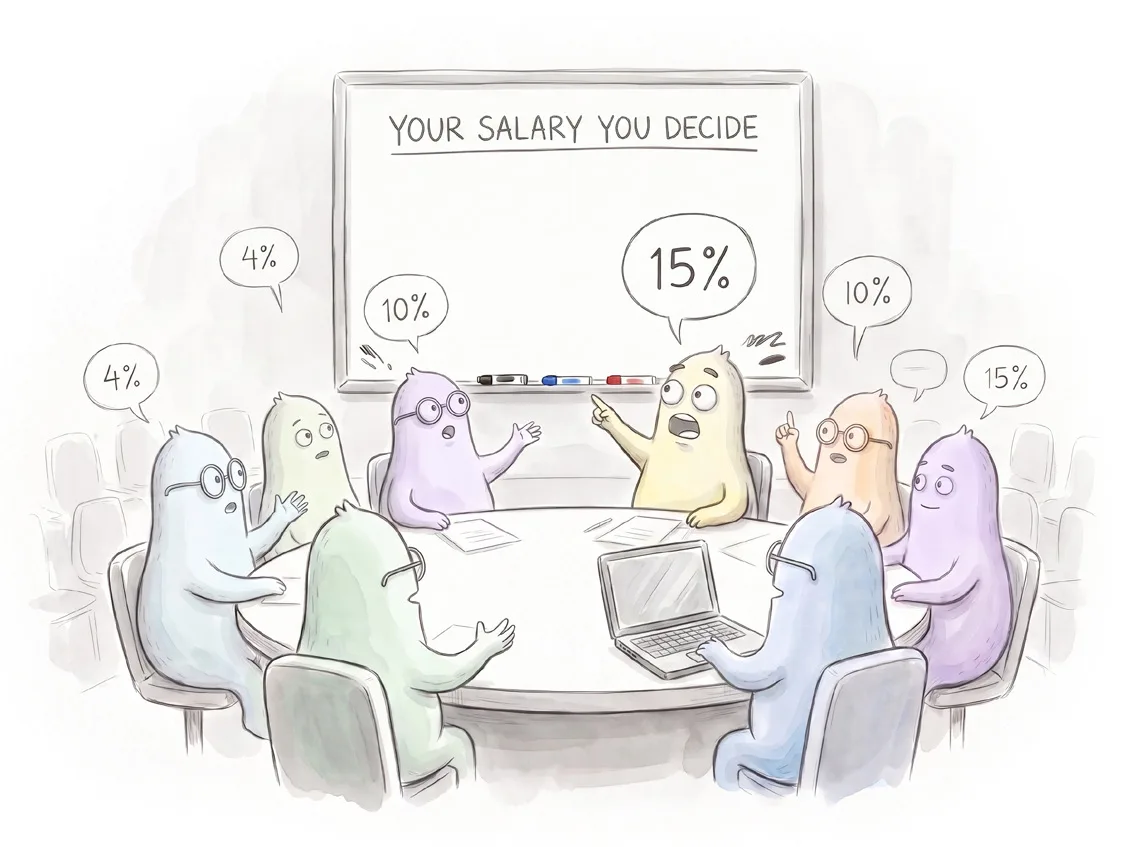
In most startups, founders decide their own salary. Or they have an external director on the board, who decides their salaries and sets goals. But we gathered our people together and asked them to decide our salaries.
“How can we do that? We don’t even know what each of you does exactly. Plus, we have never done that.” That was the common refrain.
“Not to worry,” I said. “We’ll help you decide.”
Remember the guess-the-salary game we played when opening up our salaries? We used the dozen-plus parameters people had come up with for guessing the salaries and combined them with a 30-40 min presentation by each founder on what he did in the company. We shared our prior experience, skills we brought to the table, our respective vision for Sahaj, and anything else we wanted to showcase in our presentation to the people.
This went on for three to four weeks, as we split the presentations in batches so as to space them out conveniently. And then we called an all-hands meeting for decision-making.
We asked people that rather than giving a collective number, they put founder salaries into two buckets. The idea was that among the founders, some of us had bigger responsibilities or came with relatively more experience.
We even made an ask that might sound outlandish: If the people of Sahaj thought the company had too many founders, they should tell one or two of us to leave. (The leaving founder would retain their equity but would cease to be a part of day-to-day operations, thus lightening the
opex burden for the company.)
We told them to put up tough questions before each founder, like: Why should Sahaj hire you? Where should Sahaj be in five years? Or whatever curveball they could throw at any of us.
They could be as candid as they wanted to be and ask any of us to leave Sahaj, to not be an overhead.
Most people were too stunned to say anything but some did ask a few questions, if only to honor our request or test our resolve.
But at the end of it, they all said that the founders had complementary skills and they wanted all of us to continue leading Sahaj with our respective strengths. And, more importantly, we got our first full salary decided and given by Sahajeevis.
Origins · Chapter 05
Curiosity and Sharing
In our very first two years, we made profits beyond our expectations. But rather than divvy it up among the founders alone—standard practice for startups given that it is the founders who take the risk—we once again challenged the status quo.
We were not comfortable with keeping all the money for ourselves; we wanted to reward the 40-odd people who had trusted us and slogged along with us to build this company. That was also part of reducing exploitation according to our chosen value system.
So we introduced profit-sharing to make sure all Sahajeevis got a fair share of profits Sahaj made. And this was, of course, in addition to their salaries and ESOPs.
When we announced this to our people, they said, “Wow, this is really walking the talk!”
Here again, we were transparent in how we rolled it out and involved everyone in the exercise.
We told Sahajeevis to think like a CEO and gave them boardroom access to all the data: the gross profit we made, our expenses, etc. And then we said they need to figure out what percentage of the net profit should go toward profit-sharing and what should be set aside for future growth and expansion.
Many people came back and suggested that we set aside as much as 90% for future growth, leaving only 10% for
sharing amongst people. Then I stepped in and said, “There are two kinds of leadership styles. There are people who are conservatives who want to stack a lot of cash in the bank. And then there are people who live on the edge. I’m of the latter kind.”
We argued that as long as we have trust among ourselves, we can get a little bit more ambitious and do the split like a 60%-40% or a 70%-30% (wherein the 40% or 30% was for distribution of profits).
People gradually came round to the idea, and we chose a 60-40 split for the first year.
Now to distribute the profit, we used the number of ESOPs each person had. The idea was that the higher the number of ESOPs, the higher the profit share that person would get. The logic was simple and straightforward: Since ESOPs were given based on how high a risk someone had taken, their seniority level, performance, and the loyalty and commitment shown, it formed a natural basis for allocating profits as well.
In a typical consulting company, people got a fixed income regardless of how much profit the company made. But we said no, we were going to do profit-sharing in addition to the salaries. All the hard work people put in to make the company more profitable would get rewarded in the form of extra cash in their bank accounts at the end of the year.
Sometime in late 2015 or early 2016, a Pune-based IT company reached out to us. They had read my blog about open salaries and the transparent culture we were building at Sahaj. Impressed, they wanted to know how we did it and if they could adopt some of our practices.
So I was on a call with their CEO and HR team and told them about our whole philosophy of non-exploitation, transparency, and trust. That if people wore multiple hats and experimented with different things, they would be better equipped to take care of their lives and their careers. That we do not treat people like machines but human beings that are empowered to make choices.
And yes, I said, we don’t call people resources, not even employees. “We are dead against the philosophy of using humans as resources,” I said. “The reason why we don’t have an HR department.”
The CEO wasn’t sure where this was going. The company he led had over a thousand employees and a sizable HR staff.
Swallowing hard, he asked me, “What do you suggest we should do?”
In all honesty, without mincing any words, I said, “I think you should probably get rid of your HR department if you really want to transform how you work.”
The guy started laughing, the kind of laugh that says, “C’mon, you can’t be serious.”
The HR head was offended, too, for obvious reasons. “You guys are small and present only in two offices in India; we are a thousand people spread across the globe. It’s easy for you to give gyan like this,” he said curtly.
I ended the call politely, telling them I had given my sincere advice and it was up to them how they wanted to take it. Besides, we didn’t contact them—it was they who reached out to us for ‘gyan’.
The matter ended there but the episode strengthened our resolve to prove our detractors wrong. When we started out with our rather idealistic principles, there were many who told us to our face that we wouldn’t last long. Or that we wouldn’t be able to scale it beyond 10-12 people.
Not only did we survive, we thrived—and scaled the organization to 40. That’s not very large, but big enough to get noticed, especially considering that we were mostly a bunch of senior folks with 15-plus years of experience each.
But perhaps we were still in some sort of cocoon and needed to come out in the open to be known a little bit more beyond our closed circle. Maybe it was time to go global.
The challenge was clear: We needed to spread our wings and grow our unique culture to places beyond India.
We wanted people to look at us a few years down the line and say, “Yes, you have shown that it’s possible to globally scale a services company built on openness, transparency, and trust.”
In July 2017, Nitin and I went to set up our first overseas office in the U.S.—the biggest tech market of all time. Initially, we had deliberated on the idea of hiring someone from outside but then most of us were of the view that we were still a fledgling startup and it would be better if one of us relocated.
By that time, we had some marquee names in our client list, including top-notch global consulting and tech players. We were confident that we would be able to convert prospects into clients in the U.S. as well. “Go and hire, we’ll find work,” Sunder encouraged me.
So I moved swiftly. By December, we had a 10-people team spread over two locations, Fremont in California and Raleigh in North Carolina.
Looks like the stage was set for us to arrive at the Global Arena.
Lessons from the Journey
Origins
Lessons from the journey
When the five of us planted the seeds of what would become Sahaj, we set out to challenge the status quo and reduce exploitation in the software services industry. Initially, most people dismissed our idealistic aims as wishful thinking, giving us barely a few months of existence.
But once we clearly defined our purpose and carried on in our endeavor, refusing to compromise with our values, the perseverance began to pay off. There were some early believers who helped us as well as those who took big bets on their careers—by leaving cushy or entrenched jobs with big tech brands (often with fancy roles or titles) and agreeing to join mavericks like us. Titles meant nothing if we couldn’t solve the toughest problems for our clients in double-quick speed—so people happily took on the mantle of rather plain-sounding solution consultants. If you ask me, the law of attraction begins to work even more in your favor when you are open and transparent with people.
The strategy of staying true to our values and delivering quality software and solutions to our clients did wonders for us. As simple as it sounds, it helped us win the trust and referral of our clients, which became our most effective and only sales channel for almost the next 10 years. Even today, 99% of the projects we get are because of client referrals.
Unlike other companies that usually rely on rulebooks and hierarchies to manage people, we made Sahajeevis think like CEOs and trusted them to do the right thing. A trust that was built on being increasingly transparent in terms of salaries, revenues, operational data, and whatever we could think of to make Sahaj as egalitarian and non-exploitative as possible.
Dismantling the whole employer-employee concept and creating a community of folks who love to work together on the toughest and the most challenging problems was not easy.
I, for one, have realized that more openness brings a higher sense of ownership and responsibility, and a greater degree of satisfaction as well as belongingness. Being open also helps you in challenging times like when we first tried to make a dent in the U.S. market. It made our members more understanding and our collective pain (of having to let go of people) somewhat more bearable. If anything, our first four-and-a-half years took us through ups and downs we couldn’t have anticipated but navigated successfully as a team.
While everyone was excited to see the potential of this unique entity called Sahaj—and most strategies were leading to fruition—there were some setbacks as well. We lost people along the way, some people chose to part ways with Sahaj during the early years. I remember my first encounter with unwanted attrition.
There was a person I brought in to do recruitment for us. She was very good at her job and everyone liked her; in fact, she was one of those individuals who would do anything to grow Sahaj, very aligned with our values and culture. She was the face of Sahaj for all the candidates. But I think 12 months into the journey, she decided to leave Sahaj—for reasons known only to her.
It was a shocking moment for us, particularly me, because I was the one who brought her into Sahaj. No one could believe that she was leaving Sahaj, and some of us were deeply hurt and started judging her that she was leaving for money, etc. However, Mr. B. made us realize that as we grow, such things will happen: old leaves will fall off
to create space for new ones to arrive. People will do their bit for Sahaj only till a point and then, the priorities and situations may change and they will move on to pursue something else. Such is life.
All the same, you can’t let a few upsets take your eyes off the abundant opportunities on the horizon, can you?
So, as the year 2018 began to fade away for this young sapling called Sahaj, a belief hung in the air that more sunshine lay ahead of us.
An idea that was seeded in a flight had taken the shape of a young banyan sapling and its roots were spreading and growing thick. The question was: Will this young sapling be able to weather strong winds or storms?
Can it grow into a self-sustaining big banyan tree with its branches growing in different directions?
These inspiring words from The Builders by Henry Wadsworth Longfellow come to my mind:
“Build today, then, strong and sure, With a firm and ample base; And ascending and secure Shall tomorrow find its place.”
Growth
Passion creates capacity and builds resilience. Resilience makes you come back all the time, every time.
Growth · Chapter 06
First Big Failure
Have you heard the one about the best laid plans of mice and men? Yes, they often go awry.
Our 10-member U.S. team was on our payroll from December 2017, a big dollar expense for a company that had just about 40 people in India.
Sunder and I got down to connecting with and meeting prospects, showcasing the superlative work we had done for our clients—and hoping to get them to sign up with us at our premium rates. Within a couple of months, the two of us lined up as many as 50-60 meetings in the Bay Area.
I remember people were often okay with our value proposition and promise—but they balked at the billing rate. “Are you kidding us? Who pays that kind of money?” our prospects would usually say.
And in a way, they were right. The going rate charged by most other firms in California in those days was less than half of what we were asking. Our figure was almost unheard of but we stuck to it.
“That’s who we are,” we would try to convince folks, refusing to pare down our premium positioning.
Perhaps we had also become a bit arrogant, being in Seventh Heaven after some spectacular successes and great client testimonials.
Our prospects shook heads rather than hands, walking out of the meetings.
It was a rude reality shock for us.
We did manage to get a couple of small projects. But they were merely a trickle, not sufficient to sustain our U.S. operations.
And no matter how profitable you were in India, you just couldn’t afford to pay 10 people in the U.S.—certainly not on the basis of the 40 who were earning. It’s not possible even with a 30% EBITDA, unless you are a 300-400-people company.
After a few months of struggle, we started crumbling. Panic was beginning to set.
We didn’t have enough money. We had issues in meeting our U.S. payroll first and India payroll next. There were times when the founders again went without salaries because our bank accounts were running low on funds.
At times, we told some of the trusted, core team members in India that their salaries would be delayed because we didn’t have enough money. To run the U.S. ops, India was getting massively impacted.
For the first few months, it was the India team making money and sending some of it to the U.S. to support the payroll. But considering the severe lack of new business we had hoped to get overseas, both the locations were suffering.
We were getting pushed to our limits and the load we were carrying seemed too much for the fragile back of a young startup.
We had to figure out what to do next—fast.
And then the inevitability of what was coming hit us like a sledgehammer: We had to start asking people to leave. And that was a big moment for us because we had never done this before, nor did we think of doing it in our worst nightmares.
Letting go of people we had so carefully handpicked was one of our toughest decisions.
And the decision had to be taken, given the grave reality that was staring us in the face: The high cost of payroll for 10 people in the U.S. was jeopardizing the day-to-day survival of the 40 Sahajeevis and their families back in India.
With a heavy heart, we asked our U.S. people to leave. Their notice periods were usually much shorter than what’s the norm in India, but some of them asked for more time and we accepted their request. We were forced to push them out and the least we could do was to lessen
the pain a bit by supporting them in the transition period. The only good thing, a kind of saving grace, was that people were mature enough to understand the situation.
“We, too, feel that we have not been able to add much value, so we’ll find something else,” many of them told us.
A few of them hung around till October 2018 but most of the team was gone by July.
In India the dozen or so people whose salaries had to be delayed never complained, managing their finances with a quiet dignity that made us sad and proud at the same time.
Letting go of the entire U.S. team within a matter of months was a massive failure for us and a big setback for me personally.
Somehow, we were able to avoid taking on debt but our finances were over-stretched, with salary delays extending from days to weeks, even months.
We kept our heads down and executed the projects we had in hand. Quietly and resiliently.
Growth · Chapter 07
Resilience and Perseverance
We hadn’t yet recovered from our setback in the U.S. when Raj approached me, sometime in 2018, with the proposition for opening a new office—but within India.
“I want to set up a new Sahaj office,” he said to me one day.
He already had a list of cities to choose from: Hyderabad, Coimbatore, Nagpur.
I didn’t jump at it. Nor did I want to discourage him. I ran the names of cities in my mind and shook my head.
“Why don’t you do it in Pune?” I said. I somehow liked Pune as a city and wouldn’t mind a fellow Sahajeevi setting up shop in that vibrant place buzzing with activity. My gut feel also told me that Pune would be a better bet at that moment.
“Okay,” he said, with barely a pause. “You know what, let me start with Pune; maybe I can then go on to set up Hyderabad.”
I could sense that Raj was raring to go. He had proved himself and now wanted an expanded canvas to play. With our no-fixed-roles philosophy that urged people to find multiple ways to grow within Sahaj, I agreed.
Unbeknownst to me, however, another such request awaited me in the wings!
Around the same time Pune was happening, Nitin threw the idea of setting up an office in the U.K.
We had a senior industry advisor on our board and I shared the thought with him. But he was more gung-ho on the U.S. than the U.K. as a market. Dismissing our initial failure, he said, “Maybe your strategy wasn’t right and I really think you should double down on U.S.”
Some other folks we asked told us the same thing. We were in a dilemma.
But Nitin was adamant and he had valid reasons for it. In his earlier job, he had handled quite a few U.K. clients. Besides, he was comfortable with that region in terms of how the companies operated and the cultural aspects.
I thought this over. Then I said, “Okay, let’s do U.K. Just because we failed in the U.S. doesn’t mean we would repeat it here!”
We were smarting from our recent failure but we hadn’t lost our chutzpah. Call us mavericks if you will, but we took two bets when even one sounded risky.
But this time around, we approached it a bit cautiously, learning from our failure. We didn’t let excitement and daring turn into over-zealousness.
In Pune, we started with a shared space before opening a full-fledged office. And in the U.K., Nitin first went to get the pulse of the market and see if we could get business worthy of setting up an office. He made several trips—as many as 14 in 12 months, as he later recalled—before shifting there for good.
The strategy played out well and an interesting turn of events happened that boosted our chances of success.
During one of his early trips to the U.K., Nitin contacted Josko, whom he knew from an earlier role and who was then working for an outdoor media company. That conversation began a working relationship that has continued for years.
Josko did not initially respond. A mutual connection, Anant, persuaded him to speak with Nitin and hear how Sahaj worked.
That call led to a practical challenge. Nitin asked Josko to give Sahaj a real problem, a budget for eight to twelve weeks and a team of two or three people.
“We will work on one-day’s notice. If we are not what we say we are, stop the engagement,” Nitin said.
Josko was looking for a different pace and approach
from what was then being presented as best-of-breed engineering. His challenge to Nitin was simple: prove that Sahaj could deliver better and faster.
That challenge resulted in an initial discovery led by Manoj and Nitin, with the work delivered from the U.S. The project delivered what was promised, and the relationship grew from there. When Josko later joined a much larger outdoor media business as CTO, he brought Sahaj in again.
His mandate was to transform a largely traditional media business and build its technology capability.
The first priority was a failed attempt to build an end-to-end automation platform for buying, managing, and running outdoor media campaigns. A detailed review showed that the architecture was not recoverable. The only credible option was to rebuild it from the ground up on a scalable foundation.
The timeline was extremely tight. The target launch was January 2019, and the third quarter of 2018 was nearly over. Sahaj ran a three-day workshop with the key stakeholders, and by the end, the group had agreed to the rebuild and the work could begin.
Within a few months, the on-site team had grown significantly, supported by colleagues in India. Demand increased quickly, and Sahaj had to scale the team across its Bengaluru and Chennai offices.
The work required more than technical delivery. Stakeholders held different views, and the team had to build agreement around a difficult decision. Strong technical evidence made that possible.
Priorities changed continually, as did the scope. Additional people were brought in when needed. That discipline kept the work focused and allowed the first MVP to be ready for rollout by mid-January.
The delivery established credibility across the business. It also gave Josko the confidence to expand Sahaj’s remit, including two further products.
It was then that the newly opened Pune office came into full bloom. Raj did a fabulous job of building a great team there.
In hindsight, the twin bets on U.K. and Pune turned out to be gold mines for us.
Besides supporting our work for the outdoor media company, Pune Sahajeevis rallied around another big customer we got, an Indian automobile major this time. How we bagged this project was that Sunder happened to write a congratulatory message to the new CIO of this company, who had just joined, and enquired if Sahaj could partner with them in any of their upcoming tech initiatives. He responded and put Sunder in touch with one of their digital initiative heads looking after the customer and partner engagement portfolio of business.
Sunder and the digital head connected well and had a few conversations. In one of their chats, they spent a long time discussing a performance and high resource utilization issue with one of their elastic index clusters. This long discussion and deliberation gave him the confidence that an expert team like Sahaj with no overheads could solve a lot of their problems.
This was before anything was signed between us but
it developed a bond of trust between Sahaj and the automaker. And it was this trust that landed us an opportunity of working on something big for them: Wean them away from an expensive and cumbersome system for monitoring their fleet of trucks and build their own custom solution, an IP they could own and maintain much more cost-effectively.
The system became an instant hit and, with an enhancement, it even allowed them to manage and monitor trucks manufactured by other companies—a highly valuable thing for fleet owners who had an assortment of vehicles from other brands as well. Even as I write this, lakhs of trucks are running smoothly on the solution built by Sahaj. What made it a spectacular achievement was that our Pune folks did it with just a team of 6 or 7—something that would have taken most conventional firms over 100 people (and probably taken them longer than the eight months we took). And this evolved into a one-of-its-kind custom-built connected vehicle platform for the automotive manufacturer, serving both commercial and passenger vehicle segments.
We were fortunate to meet courageous business leaders like Josko and the CTO of that automobile company. Not only were they ready to risk their jobs by trying out a new unknown brand, they were open enough to listen to our suggestions and support us through the journey. We certainly didn’t let them down, and this was a testament to our own philosophy of trusting people with information and data—and getting amazing results. Our clients were beginning to do this for us as well.
Growth · Chapter 08
Adaptation and Evolution
Much before Pune, we started our first office away from our home base of Bengaluru in Chennai. Bala was the only Sahajeevi in Chennai and he would travel to Bengaluru whenever required.
Gradually, as our business started picking up and we began to look for talent beyond Bengaluru, we thought of Chennai as the next place where we could possibly set up an office. But Bala was rather slow in that regard. His thinking went like this, “It will happen when it will happen.”
Sunder and I, on the other hand, were keen to make it happen sooner rather than later.
While we were doing this back and forth with Bala, one of our contacts from the previous organization, Prem, was returning to Chennai after a stint in South Africa. Knowing that he’s a wonderful person and a great networker, I pressed Bala to hire him in Chennai. Prem was more than happy to join us; he considered Bala a mentor and respected other co-founders as well.
And the way we started the Chennai office sort of mirrored how we did it in Bengaluru—finding one of the most cost-effective places available. It was a property owned by Bala’s brother and, initially, we bargained for spending on things like ACs and whitewashing in lieu of paying rent. Bala used to stay on the building’s first floor while our office was on the ground level.
Within a couple of months, word spread in Bala’s and Prem’s networks and more people wanted to join Sahaj. Initially, 5-6 people came from their direct contacts and, later on, these new members pulled more people from their own circles.
By the second half of 2016, we had a great team of over a dozen or so senior professionals in our Chennai office. We didn’t have a long roster of clients in the region but it served as a very good talent hub for projects we did elsewhere.
Let me tell you about a fun incident that happened soon after we started our Chennai office. It still has me in splits whenever I recall it.
As I said before, prior to the Chennai office, Bala would often travel to Bengaluru to meet us, but we never went to Chennai to meet him. Obviously, it made more sense for one guy to travel instead of four.
Now that we had a Chennai office, however, Bala wanted to invite us over. He asked us one day, “Why don’t you guys come over this time for a change? We agreed to hold our next meeting in Chennai. When the time came, Sunder went a day earlier for some client meetings. Mr. B., Nitin, and I were to join him a day later.
On the scheduled date, the three of us were traveling together in a car when Sunder called us to check when we would be arriving in Chennai. He was waiting in the office with Bala. Just then, an impish idea struck me.
“Let’s play a prank on Sunder when we reach,” I said. “We will put on serious faces and Nitin will tell Sunder and Bala that Akash and Mr. B. had a terrible fight on the way. So much so that they threatened to call it quits.”
Nitin and Mr. B. agreed to play along. When we reached the office with our sullen faces, Sunder and Bala asked us what had happened.
“Oh, Akash and Mr. B were fighting like cats and dogs on the way. I’m so fed up!” Nitin said, faking exasperation really well.
Mr. B., too, acted like he was deeply hurt, glowering at me for good effect.
“We need to have a serious conversation,” I fumed.
The five of us were talking in a meeting room in the office that had an odd assortment of furniture, including a bed.
Mr. B. was sitting on the ground, Nitin had grabbed a chair, I was leaning against a wall, and Bala and Sunder were sitting on the bed’s edge. And then, even as we were arguing loudly, Mr. B. and I started calling each other names. It did appear that things couldn’t go on between us at Sahaj like this.
Bala was completely flabbergasted and Sunder had a face longer than the Great Wall of China.
Suddenly, as Mr. B. and I were struggling to find more abuses to hurl at each other, there was complete silence. It was dead quiet for a full minute or so.
Then Sunder said, in a genuinely troubled voice, “Is that it? Is it going to be over so soon?”
I couldn’t contain myself any longer and burst out laughing, “Arrey yaar, Sunder, Mr. B., Nitin, and I are playing a prank on you guys!”
My other two accomplices joined me in laughter, first nervously, then perhaps too boisterously.
Sunder got up from the bed, saying, “What the heck!” and, with a mix of embarrassment and relief, kicked Mr. B. in the back. His kick landed harder than he intended and Mr. B. howled in pain.
Later that evening, we went out for dinner together.
Back in Bengaluru, Mr. B. got himself a large pack of Iodex: for the next few weeks, he could be seen walking around the office with a limp.
This episode still brings a smile to my face whenever I recall it. Startup founders are often embedded too deep into the day-to-day running of the business. Problems and issues keep cropping up, and there are endless serious debates on what course of action to take. But every once in a while, it is important to lighten the mood and charge the atmosphere with a different kind of energy, to let our hair down and just enjoy the fun of the moment.
As we solidified our presence in the U.K., Chennai, and Pune, apart from Bengaluru, there was one geography that kept beckoning us despite some bad history we had with the place: North America. We weren’t done with our experiments with the U.S. market yet.
After the team was let go in 2018, I remained there, biding my time and mulling our next move in what’s still the biggest tech market in the world.
Sunder as well as our board advisors were quite keen that we make a dent in the U.S. market. “Don’t write off such a
huge market,” they told me time and again.
However, I was hesitant and not sure of staying in the U.S. any longer than was necessary. In fact, I had packed my bags and sent all my belongings to India in early 2019. And then I, too, came back with my family. Personally, it’s one of the darkest chapters of my life. I literally put my entire family under fire. Without thinking about my kids’ future, I decided first to uproot them from India when they were in their most important schooling years—my son was in 9th grade and daughter, in 6th—and then, again without much thought, I decided to bring them back to India in the middle of the year. Till date, I feel guilty of having made such impulsive decisions.
But even as some of my cartons lay unpacked, I kept having more conversations with Sunder and others in the matter.
Everyone in Sahaj supported the idea of giving it more time to get things right in the U.S. The arguments kept floating in my mind.
Give it another shot!
The U.S. move is going to get us more dividends over the long term than any other market.
You have to fight it out and not let one failure bring you down.
I don’t know exactly how but, after a while, I was prepared to return to the U.S. and build the business back. One thing was clear, though: We would primarily sell offshore rather than on-site services. Also, we would focus our U.S. hiring efforts on people who could do demand generation.
When I went back, we hired a marketing guy from a big services firm where I once had a stint in India. But things didn’t work out for him and he left after some time.
Soon after, we onboarded another person, a lady with a sales background who literally floored us in the interview. A few months into the job at Sahaj, however, and there was nothing for her to show by way of results. Sunder, who was also present during her interview, was incredulous and remarked to me, part in jest and part in frustration: “Maybe we hired the twin sister of the lady who came for the interview!” The person in the interview and the person in the job were poles apart.
We kept trying like this but nothing seemed to work. And then we said, “Enough is enough! We need to get someone we can trust to our U.S. office.”
That’s when Jeff’s name flashed in my mind.
Jeff had done a lot of work for the social impact sector along with Mr. B. in their previous organization. And I had tried to get him to join us in 2017 as well. Now, when I went back to the U.S., I met him personally, trying to persuade him one more time.
But Jeff still wasn’t ready to join us, telling me that he wanted to take a break from the social sector and get back to software development for a while.
The “while” lasted about four years: He joined us eventually, in March 2023.
And when he did, some of our folks asked me, “He’s not a sales guy, so why have you decided to hire him?”
With quiet confidence, I laid out my strategy.
We had been trying to sell to the commercial world in the U.S. but it was proving to be a tough nut to crack. We were realizing that this was one country that gave two hoots to your performance in other countries. The Americans cared only if you had sold in America.
So I told the board and our founders that if we had someone like Jeff on our team, we’d be able to make headway at least in the impact world. This might not get us big profits but, with Jeff’s background, some big logos were sure to adorn our deck. American logos.
And once we got those eye-catching logos, they were sure to help open the doors to a lot of commercial clients as well.
And that’s what happened in reality. Jeff started firing from day one and we soon had some big names in the social sector as our clients. Let me say this: Jeff is a true Sahajeevi at heart—a very open and honest person who is trusted immensely by his network. He is a real problem solver and when he says someone is good, people take his word on face value and move forward.
While we were onboarding companies in the social space as key customers, we also began increasing our U.S. headcount. But we did this carefully, bit by bit.
There were a couple of people in our India team who happened to get the H1B visa lottery. They were our trusted folks who had spent a few years in Sahaj. They knew the Sahaj story, our way of working, and could easily ensure that delivery for our U.S. clients was as stellar as our reputation back home.
At that time, our big U.K. media customer was also buying companies in the U.S. and it was an opportune moment for us to place two of our people on that account. It was at a slightly discounted rate, considering the salary differential between India and Western markets, but it worked for us because we wanted to get our U.S. presence strengthened.
We were fortunate that one of our very smart data scientists, Oshin, was relocating to Canada because her husband was moving there. She happily became part of our U.S. team remotely, operating out of Toronto.
Then there was Dileep, one of our seasoned solution consultants with deep expertise in software architecture, who shifted there from Bengaluru. Also, Charan, an ex-Sahajeevi who was doing his master’s from the U.S., checked with us if we could hire him—and we did hire him, even though we had to wait a while before we could assign a project to him.
Taken together, all these tiny but thoughtful moves built up our presence again in the U.S. In addition, we brought in another of our good old connections from the previous organization, Greg, who joined us in 2024. A senior person reputed in the world of agile software delivery, he has helped us make great headway with commercial clients.
Fast forward to the present day and we are almost a dozen people in the U.S. We are doing a lot of meet-the-prospects events and other innovative marketing stuff, determined to make our mark in North America.
The opening of another of our offices abroad, in Australia, occurred bang in the middle of Covid. It was around April 2020 that we made an offer to Anand, a trusted colleague from our past worklife, to start our office Down Under.
Initially, the deal was for Anand to set up our Singapore presence but his plans changed and he landed up in Australia—and so did we.
Like many of our other bold moves, people were skeptical, even incredulous. “What, you are opening an overseas office just when Covid has hit and other companies have paused expansion?” they said to us.
But Sahaj as a company has been built on the people who believed in our purpose—as well as on the people that Sahaj believed in. And if you ask me, Anand is one of those guys with the Midas touch you would certainly want on your side.
We were sure Anand would make it work in Australia even in a tough market and an ongoing pandemic. It took
a while but he did it. For the first 4-5 months there was nothing, and then all of a sudden four senior people joined us. Now the challenge was to find work for them!
Thankfully, we didn’t have to wait too long: in early 2021, Anand signed up with our first big customer in Australia, a big financial services company. From then on, we never looked back as far as Australia is concerned.
Growth · Chapter 09
The Founder’s Oven
One of the critical success factors for a company with multiple founders is the chemistry between them, what makes them click together. How they relate to each other, what personality traits they have, how they make decisions, how they resolve differences…the works.
Sahaj was started not by one, two, or three but as many as five founders. United by a common purpose as we were, each brought their own set of peculiarities to the table.
It looks hard to believe sometimes that we have steered this company together for more than 11 years—barring Bala, who left a little less than two years after Sahaj started (but more on that later).
Let me tell you a bit about myself and my working style before I dare take some liberties with my co-founders.
I have been a super-ambitious guy focused on working hard, getting the next promotion, and ranking at the very top of my group wherever I happened to be. In my stint with one of the top Indian software services companies, for instance, there was this consolidated ranking from 1 to 4—and it would have been a shame for me to get a 2 instead of a 1 (3 or 4 was unthinkable!)
This is quite contrary to how we now run Sahaj as a non-hierarchical organization, but in those days I was a typical careerist in the corporate rat race.
Another notable thing about me is that I’m good with numbers and that’s why I ended up running operations and finance, even though I have no background in finance. I don’t know how but numbers, once they enter my head, tend to stay there for as long as I wish. Thankfully, they usually rise to the tip of my tongue at the slightest nudge to the memory.
I’m also quick to make decisions and like to live on the edge. My grandmother used to say—and this is something I would often repeat to colleagues and friends—that if you want to increase your income, you should increase your expenses. One instance where this trait came into play was when I rooted for those who wanted to allocate a greater share of our profits for distribution among Sahajeevis.
All the same, my focus at my previous organization was on improving profitability. And even at Sahaj, I have ensured unit profitability right from the very beginning— otherwise we wouldn’t have survived this far. I have also given hiring and team building a lot of my time and attention—right from day one and still continuing.
I have my follies and foibles, too. My need for speed and urge to control things, for instance, makes people perceive me as rash or impulsive—and I love that!
Sunder, on the other hand, is a completely different guy, someone with a lot of gravitas. In our previous firm where we were colleagues, there was some sort of competitiveness or rivalry between us, even though we ourselves didn’t realize it in our relationship.
Both of us were valued almost equally at that company, albeit in slightly different ways. Sunder wasn’t ambitious like me but he was a good leader. While I was the vocal
guy who liked to prod and provoke, Sunder was stable, calm, and introverted. If we were both in a meeting or gathering, people would remember both of us long after it was over, but with different impressions.
Sunder’s thoughtfulness, however, sometimes resulted in too many inputs—something that people often found baffling.
For example, if someone asked Sunder about feedback on something, he would give them so many different reasons for why it would or wouldn’t work that, by the end of it, they would be thoroughly confused in the matter.
Nonetheless, Sunder would do whatever was good for the company and he always kept himself abreast of the latest innovations in technology. He still does.
People who know Sunder and are close to him will vouch for his kindness—he makes friends all around and his friendship never ends. Sunder is one friend you can trust and call whenever you are in deep shit. Also, while people may find it confusing, I know Sunder always gives genuine and heartfelt advice to people. I am proud to have a friend and co-founder like Sunder.
Mr. B., the most senior among the co-founders, is the guy who rises above mundane matters. Responsible for setting up the India presence of the global company where we all worked, he was looked up to by one and all. An enigmatic as well as respected personality, nobody seems to recall how he was given the moniker of Mr. B.— but it stuck and refused to be shaken off when he came to Sahaj.
Always ready with the right questions to ask, Mr. B. is the most trusted person at Sahaj. One can think of him as our moral compass, the go-to person for sorting out any ethical dilemmas.
In the days leading up to our leaving the previous firm, Mr. B. and I had become close and were even thinking of planning many initiatives together—but we had to quit before that could happen.
Mr. B. is one of the most pragmatic and thoughtful business leaders I have worked with. He is straightforward and to the point. At times, he may come across as a rude awakening but—and this is the best part—he does it when you need it the most. He is someone who genuinely cares about people and one thing everyone trusts him blindly for is that he will never do anything wrong to anybody.
Now, let me talk about the youngest of all founders, Nitin. One of the best software delivery guys in business, you give him any complex project and he’ll ensure it’s delivered with elan.
At our previous organization, Nitin was in charge of one of the largest agile projects I have ever seen. With a total team size of about 200, it was spread across London, Pune, Bengaluru, and Chennai. The sheer spread and scale of the project was daunting, but Nitin pulled it off without skipping a beat.
Which is why, whenever we struggled with any delivery issues at Sahaj, people would remark without a moment’s hesitation: “Give it to Nitin; he’ll certainly be able to handle it.”
Nitin is also an out-and-out relationship person. He can take an existing but small account and grow it into a burgeoning giant—on the strength of our expertise, yes, but also in large part to his relationship-building skills.
Nitin is one person who will sit quietly in the room, listening—and then come back with a solid response that will change the course of everything that people spoke about. He has a very different but simple way of looking at things. His mannerisms, charisma, demeanor… everything is very friendly and simple. It is not serendipity but a combination of all these traits that whenever he got into any account or country, he just grew it multifold. Whether it was our first project with Prabhakar, the education project we did, our move into the U.K. market, or the media client, he has taken a small team and grown those things into something of great significance. And let me say this, clients and people just love his candor and helpful nature. He is one guy who will go to any extreme to help people— be it getting people out when they are stuck in floods, or taking care of people with food, groceries, or his own car when they arrive in a new country. He is a true people leader.
Over the years, Nitin and I have had tons of conversations and have developed a special bond between us.
Compared to the other four, Bala was relatively—what should I say?—segregated. In the sense that while we knew him from our common alma mater where we were all employed, none of us had a close relationship with him or deep understanding of his persona. But we all saw him as a person with good values, and that was enough to bring him in as a partner in our business.
Little did we know that Bala and Sahaj would effectively part ways much too soon.
Maybe Bala liked to stay in his own world that mostly centered around Chennai. He did a great job of setting up our Chennai office but somehow, we felt that he didn’t— or couldn’t—go the whole nine yards when it came to Sahaj’s potential growth and success. Possibly, some personal issues were weighing him down.
We got to know the inevitability of him leaving Sahaj after he expressed his wish to move to a temple town a few hours’ drive from Chennai. He told us he could travel to Chennai once in a month but we knew it wouldn’t be enough for a young, high-touch organization like ours. (Bala stayed on as a director for some years, without any operational role though, and we finally paid him off for his equity in the company sometime in 2023.)
With the exception of Bala, all four of us have stuck together through thick and thin. Our different personalities and working styles didn’t deter us from achieving our common goals and objectives. In fact, some of our detractors told us in the beginning that with such a motley lot as co-founders, we were bound to fail sooner or later.
With perseverance and some luck, we seem to have proved them wrong.
There’s no single formula for taking this long, often arduous journey together. But I think what has worked for us is this: We have been able to use our complementary skills and different traits to our advantage. We sort of filled the gaps for each other rather than allow them to grow into rifts.
For example, with my rash and impulsive nature, and a knack for data and numbers, I focused my energies on finance and operations. Sunder, on the other hand, being calm and with knowledge of industry innovations that put him in the good books of prospects, was all about sales and strategizing for the future. He knows how the enterprises in different industries operate and has a way of navigating through their hierarchies and business challenges. Unlike some of us, however, he’s not very organized (though he may appear to be more organized than he is!) and is not exactly inclined toward operations. But that’s all right—sales keeps him busy through and through.
Mr. B. kept us on the right track with his lateral thinking and questioning demeanor. Like Sunder, he also tends to keep away from operations but he likes to work with people and on building the organization. And, of course, he is very passionate about the social impact sector and has spent a good deal of his time working with mission-driven organizations.
Another area where Mr. B. has our back is in legal and statutory compliance. His eye for detail and focus on our core principles keep us not only out of trouble but do our bit in terms of contributing to the ecosystem in which we operate and the society at large.
Nitin, our delivery workhorse, has stepped in whenever there was a tricky or complex situation with a client. He not only brings in new customers but he can nurture and grow existing relationships exceptionally well. He has also done a phenomenal job of setting up and growing the U.K. region.
Fundamentally, we came together as one cohesive unit. We complemented each other so well that we were able
to fight, discuss, and resolve a lot of issues before they became too big to handle or stymie Sahaj in any way.
We often have marathon calls where we argue or fight with each other—but none of us ever puts blinkers to the different angle or idea that the other person is bringing to the discussion. If one person commits an error or takes a wrong turn, the other co-founders are sure to correct them or bring them back on track.
Sometimes, if one of us was not satisfied with the outcome of the discussion, they would take it to their team, get their point of view, and come back—either with more fuel for further argument or with an admission of acceptance of the original outcome.
One thumb rule we decided amongst ourselves that has helped us resolve conflicts is that, in case of a deadlocked argument, whoever is close to the area will make the final call. For example, if we have a stalemate situation on any finance or people-ops decision, then I will make the final call. Similarly, if it has something to do with clients and
sales, Sunder will decide, and so on.
It used to slow us down because the five or four of us would take so much time to deliberate—and I was particularly frustrated initially. But then I started realizing that the decisions that came out of those discussions turned out to be better for Sahaj as well as Sahajeevis. I or another founder alone couldn’t make a decision that was as well-cooked—and appetizing—as the one that came out of our ‘founder’s oven’. With more thinking heads, we were more likely to make Sahaj what we wanted it to be.
As we chart our course of action for the future of Sahaj, the four of us continue to discuss, debate, fight…and come out as collective winners.
Growth · Chapter 10
I, Too, Am the CEO
It is easy to make a handful of people believe in your purpose and core values and work with them in a fully aligned manner. But how do you create a whole organization geared toward achieving a common purpose and living collective values? And, more importantly, how do you grow it from 10 to 40, then 40 to 100 and beyond?
How do you do it when everyone knows everyone’s salary, there’s no cap on how many leaves one can take, and there are no watertight roles or grades? When everything one sees around them is as open and transparent as one can imagine?
Wise old hands of the industry often told us that with our idealism and philosophy, we wouldn’t be able to grow beyond 10 or 12 people. That when we would try to scale our organization beyond lowly double-digits, it would collapse.
I’m happy to report that it didn’t and we are here—over 200 of us spread around the world, living, breathing, working along the same philosophy and principles we started with.
How did we do that?
There are two lines popular at Sahaj that have allowed us to grow and thrive over the years. Whatever processes or bare-minimum structures we have put together to build and sustain Sahaj emanate from these:
One is, “Main bhi CEO.” (I, too, am the CEO.)
The other is, “Dil ka achha hai to hire kar lo.” (Hire a person if they have a heart of gold.)
Taken together, they signify the sense of ownership and a trustworthy character inherent in our principles of openness and transparency.
If a person comes to join Sahaj with the right intent and can take pride in owning this company, there’s no holding them back from achieving their full potential and happily belonging to the tribe called Sahajeevis for as long as they wish.
All the same, if someone cannot identify with our different way of working, they would not be a right fit. Over the years, we have often let highly skilled or talented people leave Sahaj for cultural mismatch. We even stopped short of hiring some folks who were truly brilliant otherwise (and badly needed for one project or the other). The kind that would be eagerly picked up by the big brands in tech.
When we started out, we hired a lot of people in our network who had worked with us in our previous organizations. For them, there were hardly any interviews or formal hiring processes, because we knew their capabilities and had seen them in action. It was more of a discussion to find out whether they were ready to walk the path with us.
Later on, when we had exhausted our immediate networks, we asked our direct hires who had spent some time at Sahaj and were by now familiar with what it meant to be a Sahajeevi, to bring in people from their networks.
We called people hired in this way, through direct knowledge within our networks, as Wild Cards.
A unique way of hiring, the idea of Wild Cards is that if someone who understands Sahaj and its culture wants to bring one of the people with whom they worked in the past and thinks that they will be a good fit, then more or less the entire hiring process is waived off. The thought process is simple: we believe that working with someone allows one to see and assess from close quarters rather than multiple rounds of interviews. And we trust the instinct of our people to make the right recommendations. In fact, for a Wild Card, we only do one round of discussion, to talk about the salary and give the other person a chance to choose Sahaj. The only two conditions for anyone to play this card in Sahaj are: one, they should have understood Sahaj and its culture and, two, they should have worked hands on with the person they are playing a Wild Card on.
In our 12-plus years of existence, we have played a very good hand with lots of Wild Cards. I think there were just one or two wrong calls in all that time; the rest have been hugely successful in terms of their own career as well as the growth of Sahaj. I’m personally very proud of our Wild Cards and Sahaj has been one of the few maverick companies to have introduced this concept quite effectively.
Besides the Wild Cards, we have our usual hiring process—which isn’t usual at all! Let me elaborate.
For one, our interviews are less about going on a fault-finding mission and more about looking for the potential in a candidate. We look for people who are willing to do multiple things and the lens we apply in shortlisting them is one that puts the focus on culture, ownership, and
accountability.
Another key thing about the way we hire is that rather than work with a straight-jacketed questionnaire, we keep it open and let the person talk about themselves, quiz us on whatever is playing on their mind, and become comfortable with Sahaj. It is only after developing this understanding and putting them at ease that we go ahead with testing them on their technical abilities or requiring them to go through further conversations.
The whole idea of hiring for us—instead of it being an exercise in ‘increasing the headcount’—is that we look at it from the point of view of welcoming a new member to the Sahaj family. For us, it’s bringing in someone who can share the joys and challenges of crafting great solutions with like-minded people.
Over the years, we realized that you can have 10 interviews with a person and still not know them enough to take a bet on them. So we have reduced it to a bare minimum, making it as smooth and as free of hurdles for the candidates as possible.
One of our key tenets, as I mentioned before, is that we do not treat our people as resources. So, instead of an HR department what we have is the Organization Building function. As the name suggests, the idea here is not to maximize people as resources but to build Sahaj as an organization with humans who may have different individual traits but who can rally together for our common purpose and vision.
We have put together a lean team of org builders at Sahaj, currently led by Manish from our Australia office, focused on attracting and hiring talent, onboarding
people, and making them familiar with the Sahaj way of working. Not just that, they are devoted to ensuring their long-term success or, in some unfortunate but likely cases, handhold them through separation. They would even go to the extent of keeping in touch thereafter and helping them in whatever way possible.
The presence of org builders notwithstanding, it is everyone’s responsibility to make the newcomers feel welcomed and help them settle—though ‘settle’ may be somewhat of a misnomer with the kind of fluidity we have with agile teams, flexible roles, and ongoing challenges that keep the adrenalin high.
On their part, the newcomers are expected to find their way and make their own connections inside Sahaj. Every Sahajeevi is approachable and willing to help, but they also need to take an initiative. Many companies set up formal interactions with teams when a new member joins. But we keep that open—just like most other things as you would have guessed!
In fact, one of the most remarkable things at Sahaj is the onboarding of new Sahajeevis. Unlike traditional onboarding programs and classroom sessions, onboarding for us is all about letting the new person understand and experience the real Sahaj as soon as possible. On their first day of joining, one of the respective office leads or country leaders welcomes the newcomer and talks about Sahaj (I’ll talk about office leads soon).
But here’s the interesting part: we give them a list of about 20–25 people that they should connect with and talk about Sahaj. This list is global and cuts across people in tech, delivery, sales, finance, org building, data science, marketing, etc. People are largely asked to figure out what they want to talk about with these people when
they meet them.
The idea is that they should know enough about Sahaj after these 20–25 conversations. And invariably, they do get to know a lot, for they end up discussing things like why we have open salaries, RSUs, why we do share profits and have unlimited leaves, why it makes sense to wear multiple hats, how we deliver projects, our failures and what we learned from them, among others.
In the same spirit, there are no employee manuals or thick rulebooks at Sahaj. What we have are some simple guidelines and programs to help people learn and grow (I’ll talk about these a little later in the book). And being an open organization, we look the part too—there are no cubicles or corner offices here. Everyone sits in an open, approachable workspace.
I take pride in saying that we have no written policy documents in Sahaj, be it global mobility, reimbursements, benefits, leaves, or anything else—it is all non-documented and people get to know these things through conversations.
In keeping with India’s age-old wisdom, we always prefer ‘Shruti over Smriti’—or, to put it differently, the way of curiosity and questioning rather than documentation and policies.
In this age of advanced tech tools and AI, a lot of companies in the software services industry resort to monitoring their employees. The thinking is that if they keep a hawk’s eye on their desks and computers, they will be able to squeeze the maximum productivity out of their people.
For Sahaj, such excessive monitoring and control is anathema: We trust Sahajeevis to do the right thing—for
themselves, for Sahaj, for our customers. We let them operate as freely as possible, contributing not only as team members but also as creative thinkers who can have a say in decision-making even if the outside world would look at them as juniors. To quote a line from Imagine Dragons, “They are the masters of their seas!”
While all this sounds really good, let me also say this: Doing all this responsibly is not easy. Freedom and empowerment are good but they put a lot of responsibility and accountability on one’s shoulders.
For example, with no restriction on the amount of data one has access to, one has to be on their toes every moment when it comes to what to share and what not to. Also, with a lot of these AI tools, people in Sahaj are quite careful in how to use them and share data. Another example is that, with unlimited leaves and no guideline on what is a good number of leaves, the onus is always on the individual to figure out if they are taking the right number of leaves or overdoing it. With no front-line managers, career progression is also their responsibility.
Now people have to think about their growth in a different way and keep reflecting on a yearly basis to see whether they have learned new things or not. And whether they are becoming better professionals or not.
In fact, I make this statement to everyone in Sahaj, “I am not sure if you will be successful in Sahaj but one thing I can certainly tell you is this: if you are able to spend at least two years in Sahaj, your career progression will be fast-tracked at least four-folds compared to the industry. And that will be because of how we operate.”
Growth · Chapter 11
You Decide Your Hike
Like most companies, we also do our financial planning at the end of each fiscal year for the coming year. But unlike most other firms, ours is an open and transparent process—one in which all Sahajeevis, not just the founders or the top ranking people, participate.
When it comes to deciding salary increases, popularly called the increments, most companies think of them as performance appraisals. These are tied to how the individuals performed in a particular year as well as how the company did in terms of revenue and profits. But we tend to think of it a bit differently.
We have always believed that salary hikes are indeed a borrowing from the future. When you’re giving a hike, it is based on certain assumptions in terms of how your business is going to do next year—and you’re taking a cost increase now on that account.
So when we did our first such exercise, I put this question in front of our people: How much do you want to borrow from next year’s earnings to do the hike this year? And they were like, “Wow, we never thought of salary hikes in this way!”
To make it easy—and interesting—for Sahajeevis, we played a game that we called “the hike game.” It involved playing around in an Excel sheet with a lot of “what-if” scenarios.
The sheet was populated with key numbers of our business, like revenue and profits, fixed and variable operational costs, projections for the coming year, and the like. In industry parlance, it is the annual plan for the company which is shared with pretty much everyone to decide the hike.
One column, Salary Hike (%), was kept blank and programmed in a way that if you put a certain number in a cell in this column, it would change the other numbers in the sheet.
For instance, What happens when you do a 4% hike? How much does the profit drop? How much will the cost increase? What happens when the hike is 10%? And so on.
When we played this game for the first time in our town hall, which we call Gram Sabha, there were about 40-50 of us and the Chennai office folks were on video call.
It was great fun playing this live. People would shout out a number, I would plug it into the Excel sheet and everyone could see the impact reflected on the screens around which they had gathered. Most people were conservative and put in a lower number, saying we were a young startup and should save for the future. But some, like me, were all for living on the edge and making hay while the sun shines.
My argument was that when there’s little or no sunshine, we can all come together and figure it out. As long as we are in this together and understand the risks, it’s all right.
I think we ended up deciding on a 15% average hike for the first year when we did this exercise. Of course, the mechanism for distributing it was going to take into account factors such as the experience of people, their performance, and the base salary (our thinking was that people with lower base salaries should be given a higher percentage of hike in order to make it more worthwhile for them).
We also revised the salaries of people who had agreed to join us initially at the same or even lower salaries compared to what they were drawing in their previous organizations.
Later on, when we opened global offices, we repeated the hike game. But given the difference in salary structures or levels between India and the Western countries—salaries in the U.S. and U.K. are much higher, for instance—we capped their hikes at numbers that were more in line with those geographies.
Nevertheless, we extended the same health and life insurance benefits to all Sahajeevis across the globe. More importantly, we paid 100% of the premiums,
breaking away from the standard practice of asking people to contribute their share in the payments. This was something unheard of in the industry, especially coming from an Indian company.
Over time, we evolved the hike and assessment process to make it more transparent and appealing. For one, noticing some unhappiness around (because some people got lower hikes than others), I insisted on introducing a sign-off process.
What we did was share the hike sheets for different offices amongst them and asked the people to mark whether they were ‘happy’ or ‘not happy’ with the increases given. In case of anyone not being happy with their hikes, they were required to have a discussion with the people involved in giving feedback for their performance review.
To make sure that each voice is heard and all the necessary conversations take place, we did not roll out the hikes until every single Sahajeevi—across all offices—signed off. If there were corrections in salaries that needed to be made (based on the conversations), we made those corrections; and if some “not happy” folks required more convincing as to why they should instead be “happy,” we pursued those conversations in the right earnest.
We have further evolved our overall hike process and split it into two parts—one is the individual feedback for one’s growth and the other is the salary hike. The first part has evolved into what we call self-assessment but done at a group level. It sounds weird but it’s quite interesting. So one part is we encourage people to talk to as many people as they can and take feedback on a regular basis
throughout the year. Now, at the end of every quarter or month, depending on the chosen frequency, they summarize and rate their feedback themselves, basically, do a self-assessment. They use simple categories like met expectations, exceeded them, or were below expectations.
Once this is done, we review everyone’s self-assessment in a group. For us, the closest group identity for people is their office so we do this at the office level. The office group comes together and reviews everyone’s self-assessment. If there are people who believe the self-assessment is not appropriate, they openly say so and do a 1:1 discussion with the individual. Eventually, either they revise the rating or agree with what’s there in that discussion—and in case there is a deadlock, then the office lead steps in to resolve it.
Here, let me tell you about the concept of ‘office leads’ and why we appoint one for each Sahaj office. Office leads are Sahajeevis who are our go-to person for a particular office. From taking care of logistics and administrative tasks to addressing any grievances and issues, they handle anything and everything. They also help in terms of understanding the aspirations of people in the office, their assignment to projects, and ensuring participation in cultural and other events, besides anything that needs someone’s attention. And they do all this in addition to working on projects like other solution consultants. You could say they are our knights in shining armor who have got a lot on their plate!
Once the assessments are agreed upon, the next step is applying the hikes. The budgets decided during the annual plan review are there with the offices and the entire office group decides how to distribute that budget
amongst different levels of performance ratings or groups within the office. Each office is free to use their own discretion to do this and it is entirely on the group’s choice.
All in all, I know it is tough to keep or make every Sahajeevi happy—but that’s what we have always aspired to and tried to achieve as closely as possible.
Making the assessment and hike process more participative has added a dash of excitement to an otherwise dull and tense routine. It has given Sahajeevis a bigger say in how Sahaj is run.
Growth · Chapter 12
What’s in a Name?
They say that a rose by any other name would smell just as sweet. We at Sahaj have a slightly different opinion.
On the surface, a name is just a label for something that serves as a convenience (How do you refer to something if it doesn’t have a name?) But chosen with a certain intent and carried forward with purpose, a name can acquire greater significance than just being a moniker. I have a very strong belief that vocabulary influences one’s thoughts and actions. (In India’s old traditions, for instance, naming a baby is a religious rite in itself, called Namkaran Samskar. More prevalent in olden times than in today’s rushed existence, it still finds resonance with a lot of families.)
Remember how we took great pains at choosing a name for our company? We were elated to have picked ‘Sahaj.’ And as we went about building simple solutions to solve tough problems for our clients, it was as if the name eased itself into our psyche with a simplicity matching our purpose.
Let me talk about how we came upon some other names associated with our operations or culture and their significance for Sahaj. Each one lent credence to our belief in an egalitarian, non-exploitative organization, much like the banyan tree.
We were five founders and our WhatsApp group for chatting with each other was called Sahaj panchayat. In Hindi, panchayat refers to the group of five panch or elders in
a village, who usually gather together under a banyan to discuss matters concerning the day-to-day running of their village. They are authorized to take decisions on people’s behalf (which could range from settling a local dispute to suggestions for improving the infrastructure).
As our team grew, we started having what many companies call all-hands meetings or town halls. But we wanted our own distinct name for such meetings.
We thought about it and came up with something that was like an extended, all-inclusive version of Panchayat: Gram Sabha. The word gram means village and sabha denotes a gathering or meeting usually attended by most people in a community.
Gram Sabhas at Sahaj became quite popular right from the beginning, the name itself pulling people in with a rustic, familiar appeal. For newcomers joining Sahaj, it became an attraction to look forward to—because anybody could put forth their views on anything about Sahaj without restraint. So it wasn’t your typical townhall where the higher-ups in management presented some slides and kept a few minutes at the end for questions (if any)— no. For us, Gram Sabhas became sacred shared spaces where there was sanctity, not sanctions; responsiveness, not rebukes.
I remember the intense involvement of people, their genuine curiosity and willingness to be open as well as to ask questions, and the huge satisfaction it gave us to be there with all our heart. No wonder a few of these Gram Sabhas went for as long as three or four hours. And yet, none of us were feeling ‘stretched’!
We promised each other that no matter how global we grew, we wouldn’t change the name of Gram Sabha.
It was a key part of our identity, of our roots in the soil of India.
Another name we chose was for an internal software we built for ourselves: Pravarthan. It means implementation and it reflects our ambition to implement the change required in the software consulting business. It encompassed everything we did internally—from time sheet and expenses to sales and other metrics. We wanted to be the gold standard in operational efficiency and wanted our own tool to help us in that goal.
There weren’t many off-the-shelf products available in the market at that time that worked well for a software firm like ours. So we kept working on Pravarthan and did a few iterations. However, at some point we felt that it was becoming somewhat outdated.
So we embarked upon building a new tool with a fresh new UI and more capabilities than what Pravarthan could handle. In a way, I likened our move from being operationally efficient to ‘meditating’ on operations—like doing ‘sadhana’. And that’s what gave us the name for this new internal tool: Sadhak. We continue to use Sadhak and it has served us really well in all our internal ops.
Yogis achieve a state of samadhi with their sadhana; for us, Sadhak became a samadhan (solution) for all our internal issues!
A year or so after we started Sahaj, we started experimenting with hiring engineering graduates. The idea was that we would let them hang around with a senior colleague for a few weeks and see how they shape up. We didn’t have any training division or formal
schedules—nor did we hire grads often or in great numbers. But over time, when we saw that not all such serendipitous experiments worked—even though a couple of grads did turn out to be brilliant—we started holding what we called boot camps spanning two to three weeks. These were organized around a single topic—object-oriented programming, for instance.
But we weren’t satisfied with these short interventions and wanted something more extensive and multifaceted that could bring people up to speed in a more holistic way.
Again, we went back to our roots, the way we named Sahaj and Gram Sabha and Pravarthan. We thought about it at length, mulled over a few names that came up, rejected them, and went back to thinking…then someone suggested the name Gurukul.
We all loved it instantly!
Before the British-style formal schooling system in India that one commonly sees these days, there used to be gurukuls—places of learning nestled in a forested area where a guru (teacher) would take students of various age groups under their wing. This guru would teach them everything ranging from academic subjects to household chores to martial arts, with the objective of making them well-rounded, learned individuals as they crossed puberty and became adults. It was an open learning environment where all the students were treated on an equal footing regardless of their background or prior conditioning.
On our part, we weren’t headed to any forests, of course, but the idea of an eclectic mix of people learning together in an all-round, open way appealed to us. And we adopted the name Gurukul for initiating all our grad hires going forward.
To give it a Gurukul-like feel, we bring these grads together for three months in one of the cities where we have an office. The idea is to make them stay together for this period and learn as a team. This helps in building an awesome team bond as well.
What next after Gurukul? As we continued to build our organization, more initiatives with apt names came along. After we nearly exhausted our networks, we looked at what we call lateral hires. These were experienced people working in the software services industry but not in our direct networks. I remember interacting with some of them in the initial days. While they were good at their jobs, they often were a bit confused or unsure of certain things that were second nature to people at Sahaj or to those who came from our prior organizations. This could include coding practices like agile, pair-programming, or even the idea of ‘clean code’. That is, our unique way of working with no roles, no grades, wearing multiple hats on a project, acting as an influencer—in short, being a true solution consultant.
So just when we were toying with the idea of starting something for these lateral hires, we stumbled upon another word that would soon become a part of the Sahaj lexicon: Paathshala (which means school in Hindi and Sanskrit). Before long, Paathshala became our initiative for lateral hires. Fortuitously, it happened when we were expanding our Pune office with a lot of lateral hires.
I have always been quite keen on further building people’s capabilities in Sahaj and these two initiatives—Gurukul for grads and Paathshala for lateral hires—became the conduit for the same. Together, they worked like well-oiled twin engines and propelled Sahaj forward on its high-growth trajectory.
Sahaj began its journey by handpicking people from the places we founders had worked before. And our capability building efforts in the form of Gurukul and Paathshala were showing good results. But there was one thing I felt still lacking somehow: Create a class of tech leaders who were unmatched in the industry. The best solution consultants in the world who could surmount the toughest challenges thrown at them.
After much deliberation, Priyank devised a four-week comprehensive program that we initially called, for want of a better immediate alternative, the Tech Leadership Development Program. It was designed modularly so it could be split into one-week modules spread over time (this was useful to avoid keeping senior people off live projects for long durations).
I, like many others, was not happy with the name and thought hard to come up with an alternative. I suggested parishad, which means a council (of elders or wise people).
Parishad was never accepted as the name for the leadership program. Priyank ran a democratic process and asked a lot of people for suggestions; the final choice turned out to be Manthan.
Here, let me take a slight detour and talk a little about Priyank. He is another pillar of Sahaj. A long-timer who started way back during our early days as a developer, he grew very quickly into a true solution consultant. Priyank is a born Sahajeevi and was probably always looking for a place like Sahaj before joining us. A very mature business leader, he is not afraid to ask the difficult questions and is someone who never gives up. Priyank has a rare combination of tech, business, and people skills. He is one leader everyone loves listening to,
including the founders.
Now, back to the new name, manthan—yes, the same one as in the ancient episode of Samudra Manthan (I referred to it in the first chapter of the book). Like the gods and demons who churned the ocean (manthan means churning) for nectar and other boons, Sahajeevis were going to use Manthan as a metaphor for debates and discussions for leadership and excellence in tech. And out of this ‘churning’ would emerge the next set of leaders from Sahaj—ready to slay any demons masquerading as tech challenges.
One of the best things I can say about Sahaj is our adaptability and willingness to make changes that can help us better serve our purpose. These traits have enabled us to function in the same spirit of Sahaj we started with, even after we grew beyond double digits.
Take Gram Sabha, for example. While it had become an essential part of Sahaj and most people participated in it with enthusiasm, there were a small bunch of Sahajeevis who somehow didn’t find it comfortable to speak up in the presence of a large number of colleagues. And you can’t blame anyone for that: some people are introverted or shy by nature. More importantly, they shouldn’t be forced to change their natural tendencies—unless they themselves want to.
To tackle this and provide people another, relatively smaller platform to voice their opinions, we created our own version of what many companies call Ask Me Anything (AMA). We called it Chai Pe Charcha (which means chatting over tea): One of the founders would get into a huddle with people working in a particular office and set the ball rolling for a free-flowing conversation.
It was particularly useful during Covid and enabled people to be in touch other than for work.
Sometimes, the simplest or most obvious of things can hide in plain sight—and that is what happened to the name we ultimately picked for people working in Sahaj.
For months on end after we started the company, we struggled with the perfect name and kept calling each other “members” or “people” of Sahaj. We also spoke of Sahaj as a “people’s collective” for a while. But whatever option we experimented with, we refused to call our people employees or those who worked in hiring and talent as HR. If you remember, we call this function Organization Building; and you would have realized by now that treating people as ‘resources’ is not our cup of tea.
We truly believe our Org Building team is much more than just recruiting people. They are the guardians of our culture; they are the ones who, like the founders, are thinking about who should be brought in the company and at what time. They are constantly thinking, Are the people we are talking to really the right-fit for Sahaj?
Org Builders are the first set of folks who talk to candidates and develop those relationships with them. Also, they not only bring them into the company but, given that they are the first friends for new joiners in some sense, become their buddies to make them successful as well.
So, even as we were shuffling different names, one fine day, Priyanka, a committed veteran who has worked in multiple areas ranging from operations to finance, wrote a Sahaj blog in which she referred to our people as “Sahajeevis”. Priyanka has been one of those people who have seen Sahaj go through its entire journey.
She has worked with me and Mr. B. quite closely on almost everything ranging from office operations, finance, bank relationships, insurance, global onboarding, marketing, and global mobility. She is one person in Sahaj who will never say no to any problem. If she can do something to solve it, she will. I have made her switch so many roles in the last 12 years and she has done justice to each one of them. So much so that ‘one role, one title’ cannot justify the impact that she has had on the overall organization.
“Wow, why didn’t we think of this before?” I exclaimed when someone noticed it on the blog.
A jeev or jeevi means a living being in Hindi as well as Sanskrit. And we the people of Sahaj are its living, breathing creatures, so what better way to call ourselves than Sahajeevis? By clubbing Sahaj and jeevi we are basically saying that a Sahajeevi is a simple living being.
There’s one more thing I would like to tell you here, about a special gesture for any Sahajeevi who is stuck. Who, buried deep down in a project, is struggling to cope and discovers that there’s no conventional or easy way to seek help. They would have already tried confiding in
colleagues, handling things differently, or mentioned it to their mentors within Sahaj. But what if none of this helps? What if they are stuck in a situation they find too stressful or intractable?
Here again, we took a bold step: Lift-off. This was Priyank’s brain child. Any Sahajeevi who finds themselves in a situation they can’t cope with, they can simply send an email to the founders and request to be taken off the project—no questions asked. Yes, we made it that simple: just an email with “Lift-off” and the project’s name in the subject line, and an estimated timeframe when they would like to be lifted off. Similar to how an aircraft lifts people off and takes them to a safe place, the Sahaj Lift-off would roll them off the project within that period. And being a Sahajeevi, they can rest assured that it would not be held against them or affect their future prospects in any way.
After all, Sahaj is Sahaj.
Growth · Chapter 13
Craftsmanship
Freedom and empowerment can mean different things to different people. For us at Sahaj, they have led to a string of innovations crafted by Sahajeevis—often without any involvement of the founders.
I tend to think of it like the branches of a banyan finding their way around and giving shape, structure, and stability to its emerging, beautiful canopy.
The real proof of the experiment called Sahaj was when people started taking a lot of initiatives and responsibilities on their own—and used that freedom to come up with all sorts of creative ideas. And not only that, handcraft those budding ideas into flowering innovations.
Let me share a few such innovations—client-facing as well as internal—at Sahaj over the years.
It was not easy for a lot of people to digest our “no role, no grades” model but we were clear about it right from day one and never hesitated to persist in its practice. It was necessary for us to follow this model that relied on the creative freedom and empowerment of people—enabling us to reduce wastage in software delivery by 30, 40, or even higher percentages.
I’m reminded of a client conversation in our early days with a product startup that shared with us a problem statement at a high level. Realizing that they hadn’t yet figured out half the things they wanted—and that they would probably go on discussing them for several
months—we suggested doing an MVP (minimum viable product). Not in eight or nine months. Not even in six months. But in 12 weeks flat.
Here’s how we did it: After a super-quick discovery phase, we started coding almost immediately but we did so in partnership with the client. We kept refining the scope in tune with their objectives, did incremental discoveries, came together as a loosely coupled team that innovated quite a bit along the way—and delivered the MVP within deadline.
Back then, when people used to start new projects, the discoveries or the inceptions used to be at least six or eight weeks long. But we did those quickly because of our simple yet radical approach: Let’s discuss but only as much as required to start coding. Because once you start seeing things come around, you can always keep on changing them and continuing to build the product as per your needs.
Over time, as we took this approach with more clients and persevered, our people started seeing value in it and became more familiar—and comfortable—with it. Today, they are the masters of the whole thing. Nobody in Sahaj likes to say, “Oh, you know what, let’s discuss the scope of this project for a month or two before we do it.” We talk about the scope and the requirements for two or three days—and then get right down to coding. What the world has only begun to realize—the just-in-time development model (especially with AI)—Sahaj has been practicing and perfecting for years.
The key to our innovations is that we have been encouraging people to put on the CEO hat and start thinking about different ideas and solutions that can take Sahaj
forward—with no constraints whatsoever.
One of the first outcomes of this approach appeared sometime in late 2014, when Shashank suggested that Sahaj should build a product to help the blind. His idea was to develop a guiding-stick solution for them that could work even on low Bluetooth connectivity. It would ‘talk’ to them about which turn to take, left or right; should they stop or walk around in case there’s an obstacle in their path; and whether the bus they want to board has arrived or not; and so on.
Such a solution was rare in those days and there was a lot of excitement about it at Sahaj. Shashank had taken a three-month break from his active project work to create the whole solution. We tried to sell it to the Karnataka government and even sponsored an event to market it. Unfortunately, it fizzled out over time. But it set a great example for Sahajeevis wanting to pursue innovations they could pour their hearts into. It proved they could indeed think of Sahaj as their own company and start a new product or service line.
And it didn’t stop there.
Sometime in 2019, when we were going through a rough patch in terms of people feeling bored and business not doing well, Priyank thought of something to pep things up. In those days, microservices was emerging as a hot trend and he wondered if we could build something in that area. It didn’t take him long to gang up with some young grads we had recently hired and build a couple of accelerators—which could serve as toolkits to fast-track implementation for anyone working on microservices projects. Called CRUX (a kernel library for microservices) and CLAMP (a distributed system orchestrator), the
innovations brought back the excitement that briefly went missing at Sahaj.
How we assessed the young grads itself has a little innovation tale of its own. Before Covid, we used to hire young grads from colleges by giving them a written assessment test, and once they passed it, we would take them through a coding test and then the interview. This was a manual, time-consuming process. Some of the people from our Chennai office came together and built a simple testing application. It went on to become what we called our Pravesh platform. The idea was it would act like an online assessment tool for testing people—with enough security features built-in. That idea grew into a sort of product itself. The team did a fab job of not only building a great testing tool but enhanced it during the Covid times to enable online assessments at home. The team, in fact, went ahead and tried to sell it to Anna University and they did a pilot on Pravesh.
Around the same time, data science and AI were emerging as highly promising areas in tech. Srikanth, a very enthusiastic and diligent Sahajeevi, was very gung-ho about it. He said to me one day, “Boss, we need to innovate in these areas, do something real cool.” (Known fondly as Rope, Srikanth left Sahaj after a few years but not before leaving his imprint through some of our most exciting and challenging projects.)
Srikanth kept up his pitch and we finally hired a data scientist, Sanjay, to build a data practice for us. To help him get started, we also hired a junior person with some experience in computer vision.
Despite the excitement in data science and AI, however, demand was low in those days. So our team used their
time to build an innovative product we named Wynk. It was an image recognition solution for sporting events where objects move at a very fast pace—a Grand Prix, for instance. As the cars race on at blazing speeds, the cameras have to capture all that action in double-quick time. Our solution was aimed at helping advertisers such as Red Bull who would be the typical sponsors of such events. Using Wynk, they could monitor their ads on the trackside billboards, whether they were appearing correctly, if they were played during the right time slots, whether the promised eyeballs materialized in those slots or not, and so on. It worked by recognizing sponsors’ logos even at high speeds and capturing the data on the corresponding ads displayed. The solution also helped in terms of pricing and payment of the ads.
Another innovative project where Srikanth played a key role, along with Sharath, was a mobile banking application targeted at the African market. Now this particular client had been trying to launch it with the help of a large software services firm. But even with an 80-person team and almost three years of effort, success was proving elusive. Enter Sahaj with a very lean team of barely 4-5 people and we delivered the first phase in just three months and took the first set of customers live on the new platform in eight months. We innovated like we do, refactored the whole thing, and ensured that the platform was rolled out successfully in Africa. We not only delivered the new product replacing their legacy platform, but also enabled their core engineering team both in terms of tech stack and practices to evolve the platform from there on.
As we were building our data science and AI practice, Sanjay had to leave. To fill that gap, we hired a very senior data science professional, Ravindra. With an illustrious career that included reputable names such as ISRO, Infosys Research, and Flipkart, he agreed to come
on board and help us guide the team and shape them as “well-rounded data scientists”. Among the cutting-edge work that Ravindra and his team have done is an impact project for farmers in Africa and India where they can call a helpline and get answers to all their queries—how much fertilizer to use, when to use it, when is the rain expected, what to do with a particular crop, etc.—in their own language and accent. All of this was built using an AI engine that can do speech-to-text as well as text-to-speech conversion on the fly.
While we are on social impact, let me tell you about a few more projects.
One of the most impactful innovations we have done at Sahaj was during our involvement in Covid vaccine certifications for India. Our digital certification solution plugged into the overall vaccination program, in which Sahaj worked with one of the agencies interfacing with the government. We had to think innovatively to crack the challenge of packing a lot of punch in the QR code of the app used during vaccination. The app was required to have a small digital footprint and yet function effectively and securely for issuing certificates. (We had to keep the QR code very small despite the fact that it had to have much more information compared to, say, a typical QR code for UPI).
I’m proud to say that our innovation played a small but crucial role in positively impacting the lives of over a billion people. And while other countries were still using paper-based certificates, here in India we were enabling people to easily carry theirs on mobile phones!
The digital certification solution went on to win a gold in technology at the Future of Design Awards organized by
BW Businessworld in 2023.
Another impactful innovation we are truly proud of is our partnership with Citizens of the Great Barrier Reef (CGBR) of Australia. Anand, who used to head our Australia office, led the effort from Sahaj where we helped CGBR in conserving the reef through a combination of crowdsourcing, data capture, and machine learning. The idea was this: Can we ask the tourists flocking to the reef in great numbers to share their pictures and upload them to a place where they can be stored safely? And further, can we analyze all this valuable data using computer-vision algorithms so as to assess the health of the reef and provide inputs for taking corrective action as necessary? We did this project in phases, experimenting with and improving the mechanism for capturing, uploading, and analyzing images as we went along. Over time, the effort to capture the reef images across more than 500 unique reefs (forming 15% of the GBR), termed the Great Reef Census, became one of the world’s largest marine citizen-science initiatives.
To cite one more example of our impact innovations, there’s an educational institute in Bengaluru that, among other things, looks holistically into changes in certain systems or conditions that affect a group of people living or working together. Kshitij from Sahaj helped them put together an innovative design framework for the same. Aimed at transforming the educational institute into a smart, sustainable campus, thereby empowering higher education and research about human settlements, the framework we put together was a custom-built platform engineering and IoT solution. This resulted in laying the groundwork for what would later be called the CampusOS. The institute is a national education institution committed to the equitable, sustainable, and efficient transformation of Indian settlements. Their
campus is designed to be an intelligent campus, digitally enabled to ease data collection, flow, and storage of data for learning, research, interaction, collaboration, and communication. The idea of building the CampusOS was to showcase and demonstrate the principles for sustainable living, to become a standard for other campuses across India—so that they can adopt such systems to better manage their campuses.
This is a very interesting, emerging area and we are excited to be partnering with institutions that are pioneering such efforts that are likely to gather pace as antidotes to an increasingly hot, crowded, and polluted planet.
I can go on with many more examples like these but I want to take a pause here and share with you some of the upcoming areas of innovation we are most excited about.
With ChatGPT and the new wave of AI sweeping across the world, as we began looking at the whole market space, we figured out that the whole AI tooling thing was going to become really mature. As people start using chatbots and AI agents to start coding and building things, there is going to be a massive change in how people develop software and products.
I was talking to Greg about these things in 2023 and he echoed my thoughts. And as we brainstormed about all the imminent changes becoming more prevalent with AI tooling, we wondered: Can we come up with a framework on how to do AI implementations, AI engineering or whatever you want to call it?
Can we help those organizations quickly implement AI who aren’t there yet? The ones that can do with a little help from a consulting outfit like Sahaj?
Greg was quick to latch on to that and formed a global working group comprising Shashank, Asif, George, and Karun to see how we can accelerate the adoption of these AI assistants.
And it caught fire. We started experimenting with AI assistants on a couple of projects. Our outdoor media client was very receptive to these experiments, and we kept these up by extending them to more of our clients. In the process, both the clients and we learned quite a lot together.
All these experiments and learnings enabled Karun to come up with certain principles of AI that we initially called AI Engineering. Later on, I gave it the name ‘intelligent Engineering’: it has become a framework now.
Soon, we rolled this out. Now, ‘intelligent Engineering’ is not merely about AI coding assistants. It is about using AI agents for the entirety of software delivery—right from requirements to stories, to analysis, to coding, to testing, to deployment, to production scaling…everything can be done through this framework.
In fact, George and Karun have perfected it to a place where they’re saying, “Hey, you define the requirements. And if you have set these configurations correctly, all these AI tools can actually do the entire bit with minimalistic human supervision.”
So that is the next level of innovation we are excited about.
Today, it is ‘intelligent Engineering’. Tomorrow, of course, it could be something else. But technology is just a tool— and Sahajeevis know how to adapt to wield the next best tool most effectively for our clients.
That adaptability, that learnability, that flexibility is what makes Sahaj, Sahaj.
Lessons from the Journey
Growth
Lessons from the journey
If the first four-five years challenged us in terms of proving that the experiment called Sahaj wasn’t a damp squib—that it was possible to grow a non-exploitative company that took its inspiration from the banyan—the next seven tested our ambition and resilience.
To be sure, we are not yet a big banyan—but we seem to be getting there, steady and unflinching. We have seen a few seasons of shedding leaves and growing them again. Winds of change have often pommeled our trunk and broken or damaged some branches, but our roots hold strong and we emerged stronger after the storms.
We learned from the mistakes we made and walked cautiously after missteps we took. We turned our setbacks and obstacles into the stepping stones for future success. If expansion in a geography didn’t yield results, we changed our tactics but stuck to our long-term ambition of becoming a one-of-its-kind global company.
Most importantly, we kept carving out a path where none existed and continued to challenge the status quo—in people as well as client practices for crafting the best solutions in a trustworthy, open, and non-exploitative way.
No matter what, we kept talking among ourselves, having conversations and debates, course-correcting here and there. For us, belonging—to the tree of Sahaj—has never been a corporate slogan but a matter of genuine pride and delight.
There was never a dull moment and we never stopped evolving.
The good part was that the whole banyan tree was spreading—the branches were beginning to take shape
and touch the ground. Things like setting up the Pune office and coming up with capability development programs and a lot of our innovations were all done not by the founders (the roots) but the strong branches of Sahaj.
Let me leave you with this simple but powerful quote by Maya Angelou: “Do the best you can until you know better. Then when you know better, do better.”
The Spirit of Sahaj
The future doesn’t belong to the biggest or the fastest; it belongs to the most intentional and purposeful.
The Spirit of Sahaj · Chapter 14
Experimentation: A Way of Life
Sahaj has been more than an entrepreneurial venture: it has been a social experiment—a people’s collective. It has been our way of emulating the banyan tree in a business context. But it has not been ‘business as usual,’ a phrase that often conceals more than it reveals, with all kinds of negative connotations. Exploiting resources. Exploiting people. Exploiting people as resources!
Like I mentioned in the beginning of this book, most companies operating in the ‘business as usual’ world ended up with complex, exploitative hierarchies to extract maximum profits.
It is unfortunate but true that the prevalent mindset is that of suspicion—that the party on the other side of the table is out to deceive or exploit you. The laws that regulate companies and people are written to punish those inclined to break them. The business environment one sees around, more often than not, looks as if it’s created on the premise of evil rather than goodness, of fear and compliance rather than hope and contribution.
Looking back, I’m glad the five of us didn’t take that path and challenged the status quo where we could. And even after one of us, Bala, left, the remaining four carried on in the same spirit.
The Sahaj you see today is, of course, not the doing of four or five people. Nor only of those who continue to build and evolve Sahaj even as I write this.
Every Sahajeevi whose path crossed with our organization, including those we were sad to see go and the ones we had to let go, left something of them in Sahaj just as, I’m sure, Sahaj would remain an inseparable part of their journey.
Not all of our experiments worked. And maybe it’s time to recount some that didn’t go well (except that they left us some long-lasting lessons) before I move on to taking a peek at the future and tell you about Sahaj 2.0.
For example, in one of our earlier hike exercises, someone suggested the concept of ‘need versus want.’ Need was what a Sahajeevi must have in order to lead a comfortable life and want was what they aspired for. So, someone drawing, say, ₹30 lakh as salary may say their need is for ₹35 lakh—but they may still feel that they are unhappy and ‘want’ the salary to be hiked to ₹45 lakh or ₹ 50 lakh.
Curiously, this idea sprang from a guy who said he didn’t want a hike that year because his needs were met by what he was getting.
But when we tested this idea across Sahaj by asking people to put in an Excel sheet the hiked salary amount they expected under two columns, ‘Want and Need’, we got a lot of feedback. Most of it wasn’t good: there was confusion and resentment rather than collective understanding.
Some people didn’t want to share their needs; some, their wants. Yet others questioned the merit of the whole thing. Shouldn’t the hike be decided solely based on the budget at hand? And then there were those who were apprehensive of being considered greedy if they put higher amounts in the two columns.
It didn’t work and we had to junk the concept.
Another failed experiment I would like to tell you about happened during Covid. Like most other companies, we were also struggling to keep our people motivated and engaged when they worked remotely.
Given that Sahaj operates on a flat-structure model with no hierarchies, set roles, or pre-defined boundaries, our members are permitted to explore faculties that are beyond their core areas of function, expertise, and skills. At the same time, it is a model that calls for a high level of collaboration and ownership to drive oneself, teams, and the overall organization forward. While some individuals by nature are highly motivated to do what is outside their core areas, there are others who need an external push or motivation to contribute in areas beyond their core comfort zone.
To drive this, we created a concept we called Catlyzr. It was a mechanism to appreciate and reward Sahajeevis for the extra effort they put in operationalizing certain initiatives—writing a thought leadership blog, referring someone to Sahaj, volunteering to be part of an interview or training, etc.—which contribute toward building a stronger brand and growing the business overall. It was designed as a gameplay wherein each participating member could choose a set of activities to participate in, and after completing the same, would be rewarded with points (Sahaj Coins). At the end of each financial year, a member could choose from a pre-defined set of rewards.
Some folks questioned the rationale for such incentives. “Isn’t it setting the wrong example to give incentives for what people should anyway be doing for their company?” they countered.
But we pressed on for a while, saying that we could always roll it back if we didn’t see the results.
Initially, it went off well and people were gung-ho about it. But as the contest to win the rewards was in its final leg and there was just a month or two to go, it began to produce some wrong behaviors. People wrote blogs, for example, just for the sake of winning coins rather than for the real promotional reasons for writing them. Or they put in activities that weren’t necessary or justified.
In the end, we did give a few people some great rewards (family vacations or other valued experiences). But we decided not to continue with the program as, on the whole, it didn’t turn out the way we thought it would.
The reason it failed was that it created bad behaviors instead of good ones. A sense of entitlement seeped into people’s psyche: If I do this or that activity, I must be rewarded for the same. Sometimes, it even made people forget certain basic things they ought to be doing anyway as Sahajeevis. The lure of rewards was beginning to spoil the spirit of Sahaj. And that was something we couldn’t bear, so we let the rewards program be consigned to history.
Post-Covid, there was one more failure on our part in trying to make people follow a mandate. And the mandate wasn’t different from the one issued by most companies: Back to the office!
I know what you must be thinking. We’ve always claimed or tried to be nonconformist, so how come we asked our people to return to the office?
Our reason was a bit different. We had hired a lot of
grads and were looking to put them through our Gurukul program. But we found that they were feeling a little lost since there weren’t many seniors in the office to mentor them. And then there were some client delivery pressures that could be eased if more people collaborated quickly inside the office (shouting out to the guy sitting next to you is generally quicker and more effective than trying to set up Zoom calls remotely).
So we ended up doing something that wasn’t Sahaj-like at all. We picked up the stick. We had a group discussion and decided that people should come to the office at least three days in a week. This was circulated to everyone.
But the attendance still remained thin. While some people did follow the three-days-a-week regimen, many others weren’t showing up. This wasn’t fair to those who did. We said okay, you can sign up to be remote but you’ll then have to take a cut in your salary.
From then on, all sorts of evil things began to happen, with people doing proxy attendance for others or using other means to avoid the penalty. Before we knew it, we were monitoring our people—which was dead against the philosophy of transparency and trust Sahaj is built on.
This went on for about a year. The new joinees might not have felt it but some of us who had been there right from the beginning felt that the very fabric of Sahaj was being torn apart.
Thankfully, one fine day when it was too much to bear, we rolled it back. We had a Gram Sabha in which we admitted our mistake and told people that we needed to correct it. We recounted how we made everything open and transparent at Sahaj and how people chose to do the right thing for Sahaj and for their own good. Yes, some
people tend to misuse things like unlimited leaves but the wrongs of a few couldn’t be the basis for penalizing the majority. At least not in Sahaj.
We all agreed that the way forward was to go back to our roots, to continue setting the right example and trusting people and being open with them at all times.
There’s one more failed experiment I want to share.
We were growing pretty fast in the years 2022–23 and sometime in that period we thought we must grow big— to have a greater impact and to make our voice heard in the larger world. It was as if we wanted to shout about our success as a standout organization from the rooftop.
We seemed to be getting caught up in the popular catch-phrase ‘Size does matter.’
Of course we chose our own term for this new ambition: Amplify the Impact! And after some deliberation, we decided to go the IPO route to realize it.
Our thoughts were like: “We’ll do an IPO. We’ll show it to the world that a small company like us can do an IPO and stand tall without getting corrupted.”
There were questions all around. Wouldn’t we get swayed by investor pressure? Wouldn’t it distract us from doing things our way? Can we really do an IPO at this stage?
But we brushed these questions aside and said that there was no harm in trying. We took it upon ourselves as a challenge, to do an IPO without diluting our culture or our values.
We went full-blast, letting all our engines fire. The goal of going for a public offering created an unprecedented sugar rush inside Sahaj. We began hiring aggressively and pushing for higher and higher revenue projections: 30, 40, or 60 million dollars in such-and-such time. How about a hundred million?
All this hustle made us push our people like we never used to. The word ‘more’ became part of our everyday vocabulary: build more, hire more, do more sales…more, more, more!
Within two years of launching the ‘Amplify the Impact’ move, we realized that it was weighing us down. It started making us do all the stupid things that other companies do.
One of the best things about Sahaj that has made us survive and thrive in spite of all sorts of turbulence is our resilience as an organization. Given that ownership and egalitarianism are the very core of our DNA, one of us, be it a founder or anybody else, would wake up and notice what’s going wrong. And they would then shake others
by the shoulders and say: “What the hell is going on! Why are we going against our founding principles?”
It was one such jolt that brought sanity back to Sahaj in those IPO-mad days.
Here I must add that doing an IPO itself is not a bad thing. But each organization must decide for themselves about the right timing and the lengths to which they are prepared to go for becoming a public company and, most importantly, at what cost.
For us, the cost was far outstripping the perceived benefits. We couldn’t let the soul of Sahaj suffer for seeing our body inflated with the pride of an IPO.
After this realization, we put our IPO plans on hold and went back to building Sahaj the way it was meant to be. In a more considerate, deliberate manner that would bring back the joy of being a Sahajeevi, of crafting solutions to complex challenges, of doing right by our people and clients.
All these failed experiments have taught us lessons we wouldn’t have learned otherwise. That being a Sahajeevi means liberation from the pull of the carrot and the push of the stick. That Sahaj can’t be just another company earning profits or revenues by any means. That the sapling of Sahaj planted with the seed of non-exploitation is now an adolescent tree—but that it still needs the nurture and care to grow into its full potential.
The Spirit of Sahaj · Chapter 15
Sahaj 2.0 - The Art of Possible
So, what might the Sahaj of the foreseeable future look like—Sahaj 2.0 as we call it?
Today, the world around us is changing faster than ever. In what now seems like a distant past, there were technologies evolving at a reasonable pace—whether it was C, C++, Java, .NET or any new language or framework, there was time for people to learn, adjust, and move on to the next big thing.
AI, LLMs, and the coming intelligence explosion is set to change everything. There are fears of mass layoffs across industries. Organizations of all sizes and in all countries are learning to cope and figure out a future that seems to be ahead of schedule.
Fortunately at Sahaj, as far as organization-building is concerned, we are ahead of the curve. While others are only beginning to discover the merits of a non-hierarchical structure or the benefits of being a transparent firm, we have been perfecting these traits for more than a dozen years.
Our ability to wear multiple hats on a project or play multiple roles while executing a project has allowed our people to be that highly adaptable consultant who can solve any complex problem. The idea is that by sharing information across levels, we are able to design innovative solutions.
So, what we did in 2014 is what the world is going to do now or maybe next year. This means we have a massive advantage of 12-plus years. But the questions before us are: Can we capitalize on it? Can we think futuristically and start doing things that allow us to stay ahead? Can we re-imagine ourselves in the new world and move much faster than others?
In the past, we said no to a lot of things—staff augmentation and tech support, for example. Or that we wouldn’t do outcome-based pricing or fixed pricing. Rather than spread ourselves thin, we focused on consulting work thus far. The reason for not doing this was simple: We wanted to ensure that the relationship we have with our clients is all about solving their problems and not about managing project scope to optimize profits. For us, our consultants should be an extension to the client team rather than a vendor. Now, given the changing dynamics and ambiguity around the teams, an outcome-based approach might work best.
In our re-imagining as Sahaj 2.0, we are having discussions about whether we can be flexible about certain things. For instance, can we look at building smart, self-healing systems where the system supports itself? Can we start thinking, from a people perspective, about what needs to be done in a world moving toward super-intelligent engineering?
We have always navigated the journey from a standpoint of technological changes, adapting ourselves and positioning ourselves as the folks who like to work on the toughest challenges.
It is now time to change gears once again—more quickly and continuously than ever.
One of the fundamental things that have made Sahaj survive is our adaptability. The people of Sahaj are not the typical engineers who are specialized in a particular way; they are generalists.
Better still, we are solutionists. The whole premise of every Sahajeevi being a solution consultant is that they are adaptable and can figure out the right technology or tool for a scenario in order to solve the problem at hand.
Adaptability and consulting skills are the two things that are going to define us in the new world to come. Adaptability will keep us ahead of the curve and the consulting skills will enable us with the human-to-human touch that is going to be increasingly important in a world where most tasks are routinely automated by AI.
Organizations are the building blocks of the corporate world just as plants and trees are the constituents of the forest. But these blocks or constituents do not live in isolation. They are connected to each other through mutually beneficial or competitive means.
It is my sincere belief—one that is reinforced by what we have experienced building Sahaj thus far—that the corporate world has much to learn from the wisdom of the woods.
Trees and plants in a forest communicate with and help each other through underground networks of fungi and roots. Discovered in 1997 by Suzanne Simard, a professor of forest ecology at the University of British Columbia in Canada, these are called mycorrhizal networks, and there is a growing scientific interest in studying them.
In her book, Finding the Mother Tree, Simard talks about the connections and “conversations” happening among the trees, how they “pass their wisdom to their kin, generation after generation, sharing the knowledge of what helps and what harms, who is friend or foe, and how to adapt and survive in an ever-changing landscape.”
If more organizations were to emulate their example and co-exist in an environment of sharing rather than exploiting, it would be a world built for thriving rather than cut-throat competition. A world where the norm is to empower people with information and knowledge rather than hide or hoard it for the benefit of the higher-ups or the privileged few. Where openness and trust are as natural as breathing.
The little experiment of Sahaj makes it seem possible for more organizations to come forward and coalesce into an inter-connected network of wholesome growth—not much different from the mycorrhizal networks working their magic under the forest floor.
The story of Sahaj should make bigger, better sense if it stirs something up in the wider ecosystem out there. For challenging the status quo. For being more open and transparent. For making the world, yes, an even better place.
Because in the end, it all adds up to something more valuable: